|

Sinop travel
situated on a narrow peninsula at Turkey’s
northernmost point, Sinop is like a Black
Sea island with its good-natured people and
streets where time passes slowly.

Development of the Pontic Greek
Dialect
Will Pontic Greek continue to be spoken?
Bortone (2009) believes Pontic Greek spoken
in the Pontos in Asia Minor today will
probably disappear. The challenge is to keep
the Pontic Greek dialect alive. The more
recent work of researchers like Emeritus
Professor Peter Mackridge, Assistant
Professor Pietro Bortone, Dr Theofanis
Malkidis, Ömer Asan, Dr Anthi Revithiadou
and Dr Vassilios Spyropoulos have increased
our knowledge of the dialect.
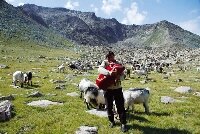
Time For to Discover the Black Sea Highlands
Discover the Black Sea
highlands in September when time is suddenly
rent by a blanket of fog or the cry of a
vulture, and make the acquaintance of nature in
its most beautiful aspect.

Formation of the First Greek Settlements in the
Pontos
According to Liddell and Scott’s An Intermediate
Greek-English Lexicon, the word Pontos stands
for the sea, especially the open sea. In time,
the word Pontos became associated with the
north-eastern portion of Asia Minor that borders
the Black Sea (see Map 1).1 The Greeks first
called the Black Sea, Aξεινος πóντος
(inhospitable, unfriendly pontos), but later it
was called Εϋξεινος πóντος (hospitable pontos)
when they became aware of its wealth in the
lands around it ...

Crypto-Christians of the Trabzon Region
of Pontos
The crypto-Christians (also called cryphi,
klosti, Stavriotes, Kromledes) were Christian
Greeks who due to the Muslim persecution against
Christians publicly declared themselves Muslims.
However, in secret, they upheld their Greek
language, customs and Christian religious
practices... | |
|
|
|
| |
|
|

The Walnut
The walnut is a fruit carefully protected by nature. Its thick outer
husk and extremely tough shell are perfectly designed to conceal the
fruit inside.
One of the world’s oldest foodstuffs, the walnut has been a friend
of man for millennia. Nor is this a friendship limited to the richly
colored natural dye made from its shell, or the scent of its dried
leaves in hope chests, or the lovely furniture made from its wood,
or the subtle and complex play of flavors its fruit produces on the
palate.
The original home of the walnut extends southward from the
Carpathian Mountains to Eastern Europe, Turkey, Iran and beyond the
Himalayas. It is thanks to the Romans that this tasty nut came to
southern and central Europe, where it also assumed the role of a
potent symbol in the development of all the folk cultures and
mystical beliefs that flourished there.
SPROUTING IN SPRING
Flowering in the early spring, the expertly designed walnut reaches
maturity in fall following an involved and magical process. It is
covered with a thick green outer husk which acts as a shield against
sudden changes in temperature. This husk, which leaves stubborn
black and green stains on the hands, is used in the production of
natural dyes. From beneath the husk a jewel of a shell emerges, so
beautiful it seems to be the work of a wood carver - the fruit, or
nut, inside it obviously so important that nature conceals it
carefully in this little shell as elegant as it is secure. Breaking
that shell to get at the nut inside is a troublesome task even
today, requiring a special nutcracker and nut picks.

MENTIONED IN THE CODE OF HAMMURABI
Full of surprises from start to finish, the walnut also numbers
among the sacred fruits of the world and is one of the foodstuffs
mentioned in the Old and New Testaments as well as in the Quran. It
is counted among the fruits of God’s mercy in Mevlânâ Jelaladdin
Rumi’s Mesnevi and Rubaiyat and used as a symbol in discourses on
human life. Lines about the walnut even appear in the famous Code of
Hammurabi, sixth king of the Babylonian dynasty, and in Roman
civilization it was Jupiter’s royal fruit. Respected as a noble
fruit among the Persians, it was used to pelt the bride and groom at
Roman weddings in the belief that it brought fertility.
MUCH LOVED IN IRANIAN CUISINE
The walnut is used in countless recipes throughout the world in
everything from soups to desserts. The Italians create a delightful
taste by stealthily adding a few walnuts to their famous pesto sauce
which employs pine nuts as its main ingredient. The French use a
roux of flour and ground walnuts when making their walnut soup. But
Iranian cuisine is the one of the biggest on the use of walnuts. In
Turkey too walnuts enjoy a wide area of application. Plucked fresh
from the branch while still green and unripe, the fruit is left to
stand in a bath of slaked lime and then cooked in sugar syrup to
produce the traditional ‘walnut taffy'. When the taffy is sliced in
two, the sight of the walnut only just beginning to ripen, its
semi-hardened woody shell, and its green outer husk is nothing short
of magnificent. And the tart, mouth-puckering syrup leaves a taste
on the palate that will take your breath away.
THE JOY OF FRESH WALNUTS
Piled high in the baskets of green grocers and street vendors, the
walnuts sold fresh in early autumn are another treat altogether. In
Turkey especially walnut is a popular flavor, and Turkish cuisine is
famous for its ‘Circassian chicken’ which uses the nuts in their
dried form. Similarly, ‘terator’ sauce, which can also be made with
other nuts, is at its tastiest when made with walnuts. Formerly used
as a topping for fresh boiled vegetables, nowadays it is served
alongside fried mussels and squid but is not usually made from
walnuts.
THAT MAGIC FRUIT
The walnut is also used as either a main ingredient in, or a garnish
on, a number of desserts, sometimes as an accompaniment to stewed
pumpkin, sometimes as a filling in baklava. Traditional baklava in
particular was always filled with walnuts, and to my mind at least
that is still the tastiest variety. It is difficult to find in any
other nut the full-bodied, caramel-like taste that comes from the
walnut and from the tannin in its shell. Walnut rolls (ceviz sucuğu)
and sheets of dried crushed walnuts (ceviz pestili) have been made
in Anatolia for thousands of years. These natural sweets are
consumed with gusto all winter long.
When it comes to healthy eating, the virtues of the walnut are
frequently extolled in the media. As I indicated at the outset,
there must be a number of valid reasons why nature has taken such
pains in producing the walnut and protecting it so carefully. You
may have noticed crows trying desperately to crack the walnut’s
shell by hurling it violently onto the ground. Such an expenditure
of effort to get that magic fruit is a sign of intelligence and
strength.
Recipes
Walnut Revani
Ingredients:
350 gr flour
15 eggs, separated
250 gr sugar
200 gr finely
ground walnuts
For the syrup:
2 kg sugar
2 kg water
juice of half a lemon
Preparation:
Place the egg whites in a bowl. Gradually adding the sugar, beat
until they form peaks. Beat the egg yolks in a separate bowl. Mix in
the flour and walnuts, then fold in the egg whites. Pour the mixture
onto a greased baking sheet and bake for 45 minutes at 140 C. Remove
from the oven and pour the cold syrup over the tart. Decorate with
walnuts.
Walnut Tart
For the dough:
250 gr flour
130 gr butter
150 gr powdered sugar
1 egg white
For the filing:
100 gr whole walnuts
500 gr walnut meats
500 gr powdered sugar
4 egg whites
4 tbsp marmalade (apple or apricot)
Making the dough:
Mix together the ingredients to form a dough. Spread in a baking
dish or pie pan, and crimp the edges.
Preparation:
Mix the walnut meats, powdered sugar and egg white to form a
filling. Spread the marmalade over the dough in the baking dish.
Then spoon the filling on top. Decorate with walnut halves and bake
for an hour in a 140 C. oven. Cool and serve.
Old Woman’s Neck (Baklava)
Ingredients:
500 gr flour
10 gr salt
2 eggs
juice of a quarter lemon
100 gr salt
500 gr butter
For the syrup
500 gr water
750 gr sugar
juice of a quarter lemon
Pour the hot syrup over the baklava while it is still hot.
Preparation:
Mix all ingredients together to form a stiff dough. Let rest for
half an hour. Divide into 12 parts, sprinkle each one with
cornstarch and roll out very thin with a rolling pin. Cover each
thin sheet with a layer of filling, roll up and place on a baking
sheet. Score in a pattern of your choice. Melt 500 gr of butter and
drizzle over the baklava. Bake around 35 minutes at 160 C., then
remove from the oven. Drain off the excess oil and drizzle with the
syrup.
Article VEDAT BAŞARAN ÖNDER DURMAZ
Usefull links
Eastern Black Sea houses, Turkey
Pumpkin recipes
UZUNGOL, Trabzon Turkey travel
Traditional Safranbolu houses, Safranbolu Turkey
Serander, Rural Architecture in the Eastern Black Sea
Region
Addresses & Phone numbers of Museums in Istanbul
Lake Efteni, Autumn
Black Lakes of Artvin province Turkey
TURKEY TRAVEL TIPS:
How
to get there Gow to get t oTurkey?
How to
get around in Turkey?
When to go to
Turkey?
What to
bring to Turkey?
What to
read for Turkey travel?
Background
Turkey
What to see
in Turkey travel?
How to plan
it?
Where to
stay in Black Sea region Turkey travel?
Turkish language
some usefull words in Turkey travel
Place names
in turkey
More info
More about
Turkish language
Job
Search in Turkey
Short History of Turkey
The Communications in Turkey
Real
Estate in Turkey
Insurance
in Turkey
Ankara Travel guide
Istanbul hospitals and doctors
The currency used in Turkey, Turkish currency
Addresses & Phone numbers of Museums in Istanbul
Izmir Travel guide Izmir Travel
tips
|
|
| |