Sinop travel
situated on a narrow peninsula at Turkey’s northernmost
point, Sinop is like a Black Sea island with its
good-natured people and streets where time passes slowly.

Development of the Pontic Greek Dialect
Will Pontic Greek continue to be spoken? Bortone (2009)
believes Pontic Greek spoken in the Pontos in Asia Minor
today will probably disappear. The challenge is to keep the
Pontic Greek dialect alive. The more recent work of
researchers like Emeritus Professor Peter Mackridge,
Assistant Professor Pietro Bortone, Dr Theofanis Malkidis,
Ömer Asan, Dr Anthi Revithiadou and Dr Vassilios Spyropoulos
have increased our knowledge of the dialect.
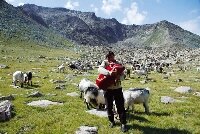
Time For to Discover the Black Sea Highlands
Discover the Black Sea
highlands in September when time is suddenly
rent by a blanket of fog or the cry of a
vulture, and make the acquaintance of nature in
its most beautiful aspect.

Formation of the First Greek Settlements in the
Pontos
According to Liddell and Scott’s An Intermediate
Greek-English Lexicon, the word Pontos stands
for the sea, especially the open sea. In time,
the word Pontos became associated with the
north-eastern portion of Asia Minor that borders
the Black Sea (see Map 1).1 The Greeks first
called the Black Sea, Aξεινος πóντος
(inhospitable, unfriendly pontos), but later it
was called Εϋξεινος πóντος (hospitable pontos)
when they became aware of its wealth in the
lands around it ...

Crypto-Christians of the Trabzon Region
of Pontos
The crypto-Christians (also called cryphi,
klosti, Stavriotes, Kromledes) were Christian
Greeks who due to the Muslim persecution against
Christians publicly declared themselves Muslims.
However, in secret, they upheld their Greek
language, customs and Christian religious
practices... |
|
|
| |
|
|

SERANDER
“Serander” are
two-story wooden structures erected on a stone bases that marry the
slope and provide a horizantal ground for the upper stories. Each
story is larger than previous one. With its empty lower story on
pillars for the purpose of ventilation, this light piece of
construction seems ready to take flight. It is an abstract structure
to be read like a system model, or a mental design.
"Serander" is placed on the stone base with four, six, or nine
timber pillars, which are solidly bracketed by slanting rafters that
emphasize the rising movement of the construction. Like an abacus on
pillars, with cylindrical plates below them that are apparently
developed to protect the store room from the other creatures of
nature, they are another manifestation of creativity.
The storage space on the upper story is surrounded by a veranda that
underlines the overall appearance. This story consists of three or
four modules and its elevation is considerably high. In some
practices, the upper units are enlarged to be added to the storage
space. Broad eaves emphasize the lightness of the structure.
This unique and astounding typological element of the Black Sea
region is constructed as a separate building that is exclusively
allocated for the preservation of foodstuff. Built next to houses,
store rooms or “seranders” inlocal idiom, are one of the most
brilliant expressions of creativity in architectural practices.
It is possible to question the necessity of such an amount of labor
spent on these painstakingly designed, decorated and constructed
elements. Although the meticulousness seems to be internalized due
to a mastery acquired by innumerable experiments in form, the "serander"
can be read as an embodiment of a mentality that wishes to dedicate
a building to the fruit of the land to consecrate it.
Starting with the points at which the pillars are attached to the
rafters, the builders of "seranders" have also developed a specific
ornamentation scheme, like the bands of geometric motifs on rafters
and openwork on parapets. Even the intersections of wooden walls are
used as a chance for embellishment or for plasticity.
In sum, the "serander" is a traditional model that is well known,
meticulously executed, and bien raffine. It is a functional as well
as a poetic model perched on the flower-bedecked slopes of the
Eastern Black Sea topography. It is to be noted down by the
contemporary architect as a source of inspiration. It is a
structural stylization. An image with thousands of associations. A
The elitist geometry of the Sagra House does not come up out of the
blue. It is an appointment with "serander” in the context of Le
Corbusier, a retreat into a local typology in pursuit of high
modernity. It is a call for a new life, silent and profound.
Batur, A. & Gür, Ş.Ö. “Rural Architecture in the Eastern Black Sea
Region”.
Istanbul 2005. ISBN 975-7235-68-7
Usefull links
Rize Travel Higlands
Traditional Safranbolu houses, Safranbolu
Turkey Travel
to Black Sea’s blue and the mountains’ green and Turkish wedding
UZUNGOL, Trabzon Turkey travel
|
|
| |