Sinop travel
situated on a narrow peninsula at Turkey’s
northernmost point, Sinop is like a Black Sea
island with its good-natured people and streets
where time passes slowly.

Development of the Pontic Greek Dialect
Will Pontic Greek continue to be spoken? Bortone
(2009) believes Pontic Greek spoken in the
Pontos in Asia Minor today will probably
disappear. The challenge is to keep the Pontic
Greek dialect alive. The more recent work of
researchers like Emeritus Professor Peter
Mackridge, Assistant Professor Pietro Bortone,
Dr Theofanis Malkidis, Ömer Asan, Dr Anthi
Revithiadou and Dr Vassilios Spyropoulos have
increased our knowledge of the dialect.
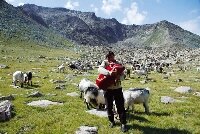
Time For to Discover the Black Sea Highlands
Discover the Black Sea
highlands in September when time is suddenly
rent by a blanket of fog or the cry of a
vulture, and make the acquaintance of nature in
its most beautiful aspect.

Formation of the First Greek Settlements in the
Pontos
According to Liddell and Scott’s An Intermediate
Greek-English Lexicon, the word Pontos stands
for the sea, especially the open sea. In time,
the word Pontos became associated with the
north-eastern portion of Asia Minor that borders
the Black Sea (see Map 1).1 The Greeks first
called the Black Sea, Aξεινος πóντος
(inhospitable, unfriendly pontos), but later it
was called Εϋξεινος πóντος (hospitable pontos)
when they became aware of its wealth in the
lands around it ...

Crypto-Christians of the Trabzon Region
of Pontos
The crypto-Christians (also called cryphi,
klosti, Stavriotes, Kromledes) were Christian
Greeks who due to the Muslim persecution against
Christians publicly declared themselves Muslims.
However, in secret, they upheld their Greek
language, customs and Christian religious
practices... |
|
|
Eastern Black Sea
houses

Shaped by the culture of the local people, Eastern Black Sea houses
peek out from the greenery like a delightful surprise...
Describing the lush greens of the Eastern Black Sea region to those
who haven’t seen them isn’t easy... It’s as if nature has used a
different shade of paint in every valley, on every ridge. As your
eyes are drawn in by the colorful palette of the steep slopes, you
suddenly notice in the distance the houses that follow you with
their eyes from between the trees. Houses of stone and timber, the
homes of the irrepressible and energetic Black Sea people, shaped by
their culture, raised and built by their hands...
CLOSED ‘CULTURAL BASINS’
Eastern Black Sea villages nestle against the slopes of the valleys
that run down to the sea from the mountain ranges parallel to the
coast. Finding a patch of level ground in these villages is
extremely difficult, and people are forced to climb up or downhill
for all their activities.
If the particular spot where you live has no view of the sea, then
you won’t find even a single horizontal line among the trees, hills
and mountains on which to rest your gaze. The road that follows a
rushing stream along the valley floor is shared by all the villages
in that valley. Since such roads only meet at the shore, the people
living in one valley have virtually no relations with the
inhabitants of even the next valley. In other words, each valley is
virtually a closed ‘cultural basin’.
The houses of the Eastern Black Sea are so scattered within the
boundaries of their village that there is usually not even a tiny
central square. Why then are houses built so far apart on the Black
Sea? The reason naturally is not that people want to avoid each
other. The sole explanation is the rough terrain. Consequently, any
spots suitable for building are snapped up with no concern for
proximity to a neighbor. This insular and solitary way of life is
universally acknowledged to be responsible for the temperamental,
contentious and ruggedly independent nature of the
Black Sea people,which has endowed them with a capacity for solving their own
problems without seeking help from others. With building materials
gathered and techniques gleaned from the environment, these people
have succeeded in constructing houses that are perfectly suited to
the region's natural conditions.

Mesudiye Ordu houses. Melet
Kotyora
STONE AND TIMBER
In this region, where erosion has thinned the topsoil, houses are
built wherever a patch of cultivable land can be found. Another
factor that influences the location of houses is water, sources of
which tend to be scattered all over the village.The building
traditions and house-plans of the Eastern Black Sea take a variety
of forms within the region, exhibiting yet other variations along
the coast. In the far east, for example, in Savsat township of
Artvin province, the houses are made completely of wood. In Yusufeli
on the other hand the side and back walls are of stone.In the
township's coastal sector we begin to find walls built by the 'goz
dolma' technique. This technique, which is widespread along the
coast of Rize, gives way to timber again as one travels inland and
upward. The minute you enter
Trabzon, the 'goz dolma' technique is
replaced by the 'muskali dolma' style, consisting of amulet-like
triangles that appear to be made of tiny cubes. (Both of the
so-called 'dolma' styles are based on a building technique of
'filling' in timber frames with stones or other materials.) In the
sparsely forested Arakli and Duzkoy valleys of Trabzon province,
there are houses, albeit few in number, whose facades consist
entirely of stone walls. The timber exteriors encountered on the
coast from the Georgian border to near Trabzon do not appear again
all the way to Ordu. Meanwhile the interior dividing walls of houses
throughout the region are made exclusively of wooden materials. All
along the coast the roofs are made of tiles, whereas in the higher
villages they are covered with thin wood shingles known as 'hartama'
or 'bedevra'.

FUNCTIONAL AND AESTHETIC
And now for the layout of the Eastern Black Sea house. Its back to
the hillside, its front overlooking the valley, the Black Sea
house's underground level is a stable for the dairy animals. Above
this is the owner's living space. Known for their innate
resourcefulness, natives of the Eastern Black Sea build their
bedrooms over the stable to take advantage of the heat radiated by
the animals on cold winter nights. On the ground floor, in the part
of the house that rests against the hillside, they make use of an
earthen floor. This section, called the 'ashane' (literally 'soup
kitchen'), is where all the daily activities are carried out. An
open fire burns in the center of this room, where food is cooked and
consumed and guests are entertained. There are no windows in this
area, for protection against any possible danger that might come
from outside. It is therefore a dark space, the only light being
that coming in through the door. The bedrooms are in the other half
of the house which overlooks the valley. While bedrooms in villages
west of Trabzon open onto the kitchen, in the eastern regions a
corridor separates the two areas in an arrangement that affords more
privacy. Meanwhile, in the coastal villages of Artvin and Rize, this
corridor becomes a large living room called a 'hayat', a light and
spacious area affording a panoramic view of the valley and a place
to pass the time on boring winter days when one is cooped up inside.
This section is heated by a stove, from whose warmth the bedrooms
benefit as well. All daytime and nocturnal activities are carried
out on the ground floor of Eastern Black Sea houses. Besides the
usual household chores, people are constantly busy raising
vegetables, tea, hazelnuts and tobacco, procuring firewood and
feeding the animals. An upper floor would naturally increase the
burden of, and the fatigue caused by, these tasks. The tradition of
having an upstairs can be seen only in the villages of Ardesen and
Camlihemsin in Rize province. Here the bedrooms are on the second
floor, which results in a substantial increase in living space.
A DIFFERENT BEAUTY: THE MANSIONS OF
CAMLIHEMSIN
It is impossible to speak of big houses without mentioning the
veritable mansions of Camlihemsin. These large, solid and imposing
structures, built in the township's central villages in the late
19th and early 20th century, dazzle the eye. But don't be fooled by
their ostentatious exteriors. They are not the homes of big
landowners or local governors. The owners of these homes are
ordinary people who have turned the money they earned working in
Moscow, Rostov and St Petersburg into homes. The accessories such as
door handles, window grilles and colored glass used in the
Camlihemsin mansions, which number some 30 to 40 in all, were all
brought from Russia. Similar mansions, albeit few in number, can
also be seen in the coastal villages of Trabzon's
Surmene and Of
townships. The most famous of them is the mansion of 'Memis aga', 4
km east of Surmene on the main road. And it’s owner really is an
‘aga’ (local landowner). Unfortunately these lovely relics of the
living culture of a period are facing extinction today. The process
of destruction began the minute the houses were left unattended when
their owners abandoned the towns and villages for economic reasons.
This year the world’s architects are meeting in
Istanbul for the
International Asian Architecture Conference in June and the UIA 2005
World Congress of Architecture, organized by the Union of
International Architects, in July. A photography exhibition
featuring the rural architecture of the Eastern Black Sea will also
open at Istanbul’s Milli Reasurans Art Gallery in July. If you can’t
go to the Black Sea, then at least visit the exhibition. As we said
at the beginning, it’s difficult to describe the greenery there, or
the red-roofed houses that bedeck the hillsides...
TEXT: MUSTAFA RESAT SÜMERKAN
PHOTO:ALI KONYALI
|
|
| |