Sinop travel
situated on a narrow peninsula at Turkey’s
northernmost point, Sinop is like a Black Sea
island with its good-natured people and streets
where time passes slowly.

Development of the Pontic Greek Dialect
Will Pontic Greek continue to be spoken? Bortone
(2009) believes Pontic Greek spoken in the
Pontos in Asia Minor today will probably
disappear. The challenge is to keep the Pontic
Greek dialect alive. The more recent work of
researchers like Emeritus Professor Peter
Mackridge, Assistant Professor Pietro Bortone,
Dr Theofanis Malkidis, Ömer Asan, Dr Anthi
Revithiadou and Dr Vassilios Spyropoulos have
increased our knowledge of the dialect.
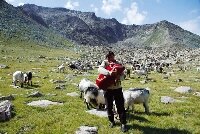
Time For to Discover the Black Sea Highlands
Discover the Black Sea
highlands in September when time is suddenly
rent by a blanket of fog or the cry of a
vulture, and make the acquaintance of nature in
its most beautiful aspect.

Formation of the First Greek Settlements in the
Pontos
According to Liddell and Scott’s An Intermediate
Greek-English Lexicon, the word Pontos stands
for the sea, especially the open sea. In time,
the word Pontos became associated with the
north-eastern portion of Asia Minor that borders
the Black Sea (see Map 1).1 The Greeks first
called the Black Sea, Aξεινος πóντος
(inhospitable, unfriendly pontos), but later it
was called Εϋξεινος πóντος (hospitable pontos)
when they became aware of its wealth in the
lands around it ...

Crypto-Christians of the Trabzon Region
of Pontos
The crypto-Christians (also called cryphi,
klosti, Stavriotes, Kromledes) were Christian
Greeks who due to the Muslim persecution against
Christians publicly declared themselves Muslims.
However, in secret, they upheld their Greek
language, customs and Christian religious
practices...
|
|
|
| |
|
|
Development of
the Pontic Greek
Dialect
|

Article Sam
Topalidis 2009
[email protected]
History of the Greek
Language
According
to Encyclopaedia Britannica
(2005), the form of Greek
written and spoken today evolved
in four phases; Ancient Greek,
Koine (also called Hellenistic
Greek), Byzantine Greek and
Modern Greek. [Others may
consider there were no breaks in
the continuous historical
development of the Greek
language.]
Encyclopaedia Britannica (2005)
states Ancient Greek is divided
into Mycenaean Greek (14th–13th
century BC) and Archaic and
Classical Greek (8th–4th century
BC), which date from the
adoption of the alphabet. The
development of five letters to
signify vowel sounds was the
principal innovation of the
Greek alphabet.
The language of the Archaic and
Classical periods consisted of a
number of dialects as a result
of the Dorian invasions [which
began around 1100 BC] of Greece
and later of overseas Greek
colonisations. These dialects
comprised a West group
(including Doric), an Aeolic
group, an Ionic-Attic group, and
an Arcade-Cypriot group.
Koine was spoken from the 4th
century BC to the 4th century AD
and it arose from the
establishment of Alexander the
Great's empire. Its main basis
was the Attic dialect, with some
Ionic features. Koine unified
the formerly fragmented local
dialects and simplified Greek
grammar in the course of its
expansion throughout the
non-Greek-speaking areas of the
Hellenised world. The Atticists,
who urged that the Classical
language be used for all
writing, dismissed Koine as
‘impure’. Their suggestion was
adopted, and thus the written
form, known as Byzantine Greek
(5th–15th century AD), stayed
rooted in the Attic tradition
while the spoken language
continued to develop. A chasm
between the written and spoken
languages opened and gradually
widened. [Mackridge (1985),
states Greek became the official
language of the Byzantine Empire
in the 6th century AD.]
Modern Greek ‘could be
considered’ to date from the
15th century and is of two
kinds. One includes all the
local dialects. The other is
Standard Modern Greek, which is
the official written and spoken
language of Greece. Standard
Modern Greek emerged from the
convergence of two historical
varieties of modern Greek -
Demotic, which was understood by
almost everyone; and
Katharevousa, the ‘pure’,
archaizing written language used
in administration and other
areas of public life. In 1976,
Demotic was declared the
official language of the state,
replacing Katharevousa in
government documents, newspapers
and education.
Distribution of Pontic Greek in
Asia Minor
The
north-east corner of Asia Minor,
which borders the Black Sea (see
Map 1), is known as the Pontos.
Greeks colonised this region
from the 7th century BC and
lived there until the last
Christian was forcibly expelled
in 1923. These Pontic Greeks
spoke a dialect called Pontic
Greek.
Mackridge (2007) in Topalidis
(2007) states that:
Pontic Greek is a dialect of the
Greek language that is largely
derived, like almost all the
other modern Greek dialects,
from the Koine (common) Greek of
Hellenistic and Roman times (4th
century BC – 4th century AD). It
probably began to become
markedly distinct from the rest
of the modern Greek dialects
after the Seljuk invasions of
Asia Minor [in the 11th century
AD], which split Pontus from the
other regions of the Byzantine
Empire. However, some older
features of the Greek language
that disappeared from other
Greek dialects were retained in
Pontic, while some innovations
seem to have taken place in
Pontic under the influence of
other Greek dialects even after
the medieval period. In its
vocabulary, Pontic has been
influenced by Persian and
Caucasian languages, and in
recent centuries it has taken on
a large number of loanwords from
Turkish.
Mackridge (1991) states that
when Pontic Greeks moved into
Russian speaking areas, Pontic
Greek also acquired a large
number of Russian words. He also
states that although many Pontic
Greeks believe their language
stems from the ancient Ionic
dialect, the linguist Hatzidakis
(1892 and 1930) demonstrated
that only a couple of
undoubtedly Ionic words could be
found in Pontic Greek.
The Greek linguist
Triandafyllidis (1981 [1938], p.
290) in Nicholas (1999) divided
Pontic Greek into three groups.
‘Oinountiac in the western,
non-contiguous part of the
Pontos from Inepolis to Oinoe.
Trapezuntiac on the eastern
shore of the Pontos, from
Kerasounta [Giresun] to Ophis
[Of], Chaldiot was spoken in the
Chaldia region, south of the
eastern shore, and including
Gumushane and its surrounding
villages, as well as the
southern mining colonies and the
coastal town of Kotyora [Ordu].
Dawkins (1937) established that
the printed Pontic of Rostov on
Don (see Map 1) is also Chaldiot.
Nicholas (1999) agrees with
Papadopoulos (1955) who limits
himself to a two-way distinction
between Oinountiac and
Trapezuntiac-Chaldiot, given
that Oinountiac tends to pattern
more closely with mainstream
Greek. Nicholas refers to these
two variants as Western and
Eastern Pontic.
Hionides (1996) believes that
the Pontic dialect remained so
remote from the other modern
Greek idioms that to the ear of
the rest of Greece, it sounds
like a foreign language.
 Map 1 The
Black Sea (King 2004, p. xvii)
Map 1 The
Black Sea (King 2004, p. xvii)
Pontic Greek Dialect in Of
Dawkins
(1937) states the most archaic
form of Pontic Greek survived
among the Moslems of Of (east of
Trabzon, see Map 1). Hionides
(1996) states Pontic Greek is
spoken by the Turkish people of
the provinces of Of and Tonya
[south-west of Trabzon]. In
1985, he counted eight villages
in the province of Tonya, 21
villages in the province of Of
and five villages in the
province of Surmene where the
Turkish population spoke Pontic
Greek. He also mentions that
many Turks in Trabzon also
fluently spoke Pontic Greek.
However, Asan (1996) states that
60 villages in the Trabzon
region with 40 of these villages
in the Of region speak Pontic
Greek.
Mackridge (n.d.) at:
www.omerasan.com/eng/home.html
accessed on 28 December 2008,
describes Ömer Asan’s important
1996 work:
ever since their conversion to
Islam, the Greek-speaking Pontic
Muslims have not been exposed to
any other kind of Greek than
their own; nor did they have
much close contact even with
their Christian neighbours in
Pontus. This means that their
speech has preserved many
archaic features that have now
almost or completely disappeared
from the Pontic spoken in
Greece. (It should be said that
their speech has also lost a
large number of words that have
been replaced by items of
Turkish origin.) Ömer Asan's
village, like the village where
I have carried out my own
linguistic fieldwork, is
situated in the district of Of,
east of Trebizond, which is home
to the largest concentration of
Greek-speakers in Pontus today.
The Of district is the
easternmost area in which Greek
has been continuously spoken
without interruption since
ancient times. If Pontic is a
peripheral dialect of Greek,
then the sub-dialect of Of is a
peripheral version of Pontic.
Like most peripheral dialects,
the speech of Of preserves an
exceptional number of ancient
words and grammatical features.
For this reason the study of the
sub-dialect of Of can throw
fascinating light on the
historical development of the
Greek language.
… it has been fascinating to
compare the vocabulary and
grammar of Çoruh, as he [Asan]
records them, with the
linguistic material that I and
others have collected from other
villages in the Of district and
from other parts of Pontus both
before and after 1922. The
variety in vocabulary and
grammar between one village and
another just a few miles away is
extraordinary, and we would
ideally like to have such a
study of every Greek-speaking
village in Pontus.
Ömer Asan’s article, ‘Trabzon
Greek: a language without a
tongue’ at:
www.omerasan.com/eng/home.html
accessed on 27 June 2009
(updated 2005), states that:
it was in the Greek language [Pontic
Greek] that the inhabitants of
the Solaki Valley [near Of]
(apart from the late comers)
were introduced to Islam and in
which the imams in question were
educated. … Actually, there is
no more natural and logical a
way of learning any sort of
unfamiliar thought, doctrine or
religion than through the mother
tongue.
… Of the various Greek dialects
in existence at the present day,
Trabzon Greek, the language
closest to ancient Greek … has
been sacrificed to religious,
national and political intrigue
and impotence. Although there is
no prohibition of any kind in
place, Trabzon Greek, labelled
by religious bigots as a ‘giaour’
[outside the Islamic faith]
language, by nationalists as an
‘enemy’ language and by
bureaucrats and politicians as a
‘separatist’ language, has the
misfortune of being listed at
the head of merely local, not
national, languages.
Asan’s (1996) ‘courageous’ work
in Turkish on the culture of a
minority group has been
criticised in Turkey, where the
government prefers to pasteurise
its cultural past. Asan should
be congratulated, not condemned
for his work. We should all
embrace and respect our cultural
diversity as an essential part
of our identity.
Revithiadou and Spyropoulos
(2006) have also studied Pontic
Greek spoken by people from Of
who had settled in the village
of Nea Trapezounta in northern
Greece. Drettas (1999) in
Bortone (2009) estimated that
300,000 people in Greece speak
Pontic Greek.
Romayka
Bortone
(2009) states Muslim Pontic
Greek spoken around the villages
of Of, has no history,
especially for its speakers.
They have no written records and
many of their speakers do not
even know that the language is
related to Greek. Some do not
know which parts of their speech
is Turkish and which is their
local ‘other language’. Many
call it Romayka, but never
Pondiaká or Eliniká. Romayka is
not formally taught and has no
standard of any kind.
Bortone (2009) states that many
Pontic Muslims report that they
did not learn Turkish until they
went to school. He also believes
that Romayka will probably
ultimately disappear.
Interesting to note, from an
email I received from a Trabzon
local, that in 2008, five and
six year olds in a school in a
village of the town of Hayrat,
near Of, were observed by their
teacher to speak Pontic Greek (Romayka)
as their native tongue.
Bortone (2009, p.83) states,
Greek peripheral dialects have
archaic traits; but the Greek of
the Of region has traits lost
everywhere else.
… we would do well to emphasize
the archaic nature of Romayka,
if only because of the implicit
irony: its archaic character is
due to the very fact that
Romayka has been isolated from
the Greek tradition.
Pontic Greek in the Soviet Union
Pontic
Greeks had been emigrating to
the Soviet Union, including
Georgia, in significant numbers
from the 18th century.
The first census of Imperial
Russia, based solely on the
criteria of language, suggested
that 186,925 Greek-speaking
Greeks (105,169 in the southern
Caucasus) lived within the
borders of the empire in 1897 (Agtzidis
(1997) in Sideri (2006)).
Dawkins (1937) states the number
of Greek speakers in Russia was
considerable. Correspondence he
received from Professor Semenov
of Rostov on Don (see Map 1)
stated that there were 60,000
Greeks at Mariupol
(south-eastern part of Ukraine,
on the coastal region of the Sea
of Azov) and 100,000 at Rostov
on Don (the latter all speaking
Pontic Greek). Sergievsky (1934)
believes there were around
97,000 Mariupol Greeks, of whom
some 82,000 spoke Greek.
Mackridge (1991) states the
Greek dialect spoken by the
Mariupol Greeks differs markedly
from Pontic Greek, though the
two may be distantly related.
Dawkins (1937) states the Pontic
Greek dialect of the Gumushane
district (south of Trabzon)
agrees with the Greek of Rostov
on Don. He believes the great
mass of the Rostov population
came over to Russia from this
district in the Pontos.
At the time of the October
Revolution in Russia, Karpozilos
(1999) estimated that the Pontic
population in Russia to have
been more than 350,000
concentrated in 34 urban centres
and in about 287 villages. He
also states that between the two
World Wars in Southern Russia
and Caucasus that it was a
serious issue in which form of
Greek would books and Newspapers
be written. Formal Greek (Katharevousa),
Demotic Greek or Pontic Greek.
Karpozilos (1999, p. 148)
states:
to raise the Pontic dialect to
the level of a language for the
Greek minority posed great
problems. The dialect had never
been systematically written; it
had a rather limited vocabulary
that lacked the words and idioms
to convey abstract and
sophisticated ideas; it also
lacked the proper words for
several new political and social
concepts. …
In schools, it was agreed that
the children should be taught
demotic Greek, but for the
instruction of the masses it was
thought best to use both
dialects - in newspapers,
pamphlets and various other
publications. This important
decision was taken … on 10 May
1926.
Joseph (2003) states, in the
1970 Soviet census, 336,869
citizens claimed Greek ethnicity
but only 39%, gave Greek as
their native language. In the
1979 census, 344,000 declared
Greek as their ethnic status.
Hionides (1996) was of the view
most of these 344,000 spoke
Pontic Greek.
Conclusion
As human
beings first, and nationalists a
distant second, we should
embrace our cultural history and
revel in its diversity and not
pasteurise it for the benefit of
national conformity. With this
embrace, we can also learn to
respect other people's languages
and cultures.
The history of Pontic Greek (and
how it probably began to become
markedly distinct from the other
Greek dialects from 11th century
AD) and the Greek language is
fascinating and should be
documented and studied.
Will Pontic Greek continue to be
spoken? Bortone (2009) believes
Pontic Greek spoken in the
Pontos in Asia Minor today will
probably disappear. The
challenge is to keep the Pontic
Greek dialect alive. The more
recent work of researchers like
Emeritus Professor Peter
Mackridge, Assistant Professor
Pietro Bortone, Dr Theofanis
Malkidis, Ömer Asan, Dr Anthi
Revithiadou and Dr Vassilios
Spyropoulos have increased our
knowledge of the dialect.
Pontic Greek is still spoken
today in Asia Minor, and by the
Pontic diaspora in Greece and at
least in countries like Georgia,
Russia, Ukraine, Germany,
Canada, Australia and the USA.
Drettas (1999) estimated 300,000
speakers exist in Greece. Who
could estimate how many Pontic
Greek speakers actually exist
worldwide today? Are you one of
them?
References
Agtzidis, V
1997, Parefxinios diaspora. I
Ellenikes egkatastasis stis
vorioanatolikes periokhes tou
Efxinou Pontou, [in Greek, Black
Sea diaspora. The Greek
settlements in the northeastern
Black Sea], Kiriakidis Brothers,
Thessaloniki, Greece.
Asan, O 1996, Pontos kültürü (in
Turkish), Baski Istanbul, Belge
Yayinlari.
Bortone, P
2009, ‘Greek with no models,
history, or standard: Muslim
Pontic Greek’, in Standard
languages and language
standards: Greek, past and
present, (eds) A. Georgakopoulou
and M. Silk, Publication 12 of
the Centre for Hellenic Studies,
King’s College London, Ashgate,
Surrey UK, pp. 67-89.
Dawkins, RM 1937, ‘The Pontic
dialect of modern Greek in Asia
Minor and Russia’, Transactions
of the Philological Society, pp.
15-52.
Drettas, G
1999, ‘To ελληνο-ποντιακó
διαλεκτικó σύνολο’, [in Greek]
in Χριστίδης, A.-Φ. et al. (eds)
Διαλεκτικοί θύλακοι της
ελληνικής γλώσσας, Athens, pp.
15-24.
Hatzidakis,
GN 1892, Einleitung in die
neugriechische Grammatik, [in
German] Breitkopf & Hartel,
Leipzig.
Hatzidakis,
1930, ‘Einiges über das
pontische Griechisch’, [in
German]
Byzantinisch-Neugriechische
Jahrbücher, no. 7, pp. 383-7.
Hionides, C
1996, The Greek Pontians of the
Black Sea, Boston,
Massachusetts.
Joseph, BD 2003, ‘Some
reflections on Greek in a Slavic
context, in both academia and
the real world, with an overview
of Greek in the former Soviet
Union’, in Balkan and Slavic
Linguistics, in Honour of the
40th Anniversary of the
Department of Slavic and east
European Languages and
Literatures (Ohio State Working
papers in Slavic Studies 2) ed.
by D. Collins & A. Sims (2003),
Columbus Ohio State University,
pp. 93-101.
Karpozilos,
A 1999, ‘The Greeks in Russia’,
in The Greek Diaspora in the
twentieth century, (ed. Clogg),
St Martins Press, New York, pp.
137-57.
King, C 2004, The Black Sea: a
history, Oxford University
Press, Oxford.
Mackridge,
P 1985, The modern Greek
language- a descriptive analysis
of standard modern Greek, Oxford
University Press, Oxford.
Mackridge,
P 1991, ‘The Pontic dialect: a
corrupt version of ancient
Greek?’, Journal of Refugee
Studies, vol. 4, no. 4, pp.
335-9.
Mackridge,
P 2007, Personal email.
Nicholas, N 1999, The story of
pu: the grammaticalisation in
space and time of a modern Greek
complementiser, PhD thesis,
University of Melbourne,
Australia.
Papadopoulos, AA 1955, Ιστορική
Γραμματική της Ποντικής
Διαλέκτου (in Greek, Historical
Grammar of the Pontic Dialect),
The Committee for Pontic
Studies, Athens, supplement 1.
Revithiadou,
A and ‘Ofitika Pontic: a report
on the dialect and its people’,
Spyropoulos,
V 2006, e-posted paper at:
www.revithiadou.gr/files/reports_on_dialects/Report_OP.pdf
viewed June 2009.
Sergievsky,
1934, ‘The Mariupol Greek
dialects: an attempt at a brief
description’, Bulletin de l’
Académie des Sciences de l’
U.R.S.S., Classe des sciences
sociales, no. 7.
Sideri, E
2006, The Greeks of the former
Soviet Republic of Georgia:
memories and practices of
diaspora, unpublished PhD
thesis, Department of Social
Anthropology, School of Oriental
& African Studies, University of
London.
Topalidis, S 2007, A Pontic
Greek History, Canberra,
Australia. (Available by
emailing author at:
[email protected]).
Triandafyllidis, M 1981,
Νεοελληνική Γραμματική: Ιστορική
Εισαγωγή, (in Greek,
(1938), Modern Greek Grammar:
Historical Introduction),
Salonika, Aristotle University.
I warmly thank Assistant
Professor Pietro Bortone for
sending me an early copy of his
2009 paper.
|
|
| |