|
|
|
Trabzon travel guide, Trebizond tour guide

Trabzon, Trebizond, Trapezus:
whatever transitions the name has undergone since the merchants of Sinope
founded it in the 8th century BC, this city on Turkey's Black Sea coast has
always had an exotic ring to Western ears. This is one of the legendary names of
history: Don Quixote dreamed of himself as Emperor of Trebizond; the great
travellers Strabo, Marco Polo and Evliya Çelebi sought out the city, while
Napoleon claimed descent from the Comneni dynasty.
In spite of the difficulty of crossing the steep coastal mountains, Trapezus
somehow managed to become an important cntrepot for trade to the east. During
the Byzantine period all the caravans from Persia and beyond with goods to sell
to Europe found their way here.
The city reached the peak of its glory in 1294 when the Crusaders sacked
Constantinople. Alexis Comnenus, a member of the former dynastic family whose
intrigues contributed much to the Byzantine decline, escaped from the fallen
city; in his flight he raised an army of mercenaries in Asia, occupied Trebizond
and proclaimed it capital of a new empire, headed by himself under the title of
Grand Comnenus.
Alexis had chosen well; his new city was impregnable and brought him a good
income. He and his successors brought all the oriental luxury and ceremony of
Constantinople with them. They spread Trebizond's fame throughout the world. Its
military fortunes rose and fell; at its greatest extent it occupied all the
Black Sea coast, but near its end, only the city itself.
The Comnenes, like all great, dynasties, were always careful to marry well.
Contemporary accounts suggest, that the dynasty's greatest, resource was preLLY
princesses, much desired by the neighbouring monarchs and rulers. 'this allowed
the Grand Comneni to keep their web of alliance intact at all times.
By the middle of the 15th century, unfortunately, the only neighbour Trebizond
had left was the voracious Ottoman
sultan, who already had enough wives and was
not tempted by the young princesses. After Melunet the Conqueror captured
Constantinople, Trebizond, the last free Greek stale, was obviously the next on
his list. He duly appeared in 1461, with the greatest army and fleet ever seen
in the Black Sea, before or since. In made the desired impression on David
Comnenus, The last emperor, who surrendered the city without, a shot. One of his
daughters was then married to Mehmet the Conqueror's son Beyazıt. The Turks
renamed the city Trabzon. As Genoa, and later Venice, drew off all the Eastern
trade for themselves, the world importance of the city gradually declined. The
Russians captured the city in 1916, during World War 1, and did considerable
damage. Luckily many of the important ruins survived.
Trabzon today is an exciting and thriving city. It is a centre of international
tourism and business, and, due to its location, thrives from trade with the CIS.
Its port is busy, its suburbs expanding, and its football team is consistently
one of the most successful in Turkey.
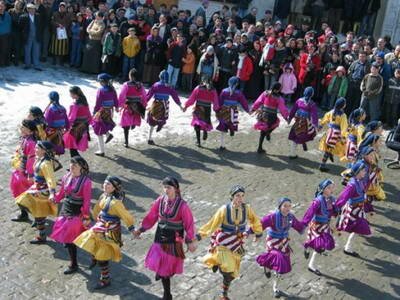
Citizens of Trabzon earn their living mostly from the land and the sea, fishing
for the delicious hamsi, or anchovy, that is the culinary speciality of the
region. Fast of Trabzon is prime leapicking terrain, providing the Turkish
public with those: vital leaves. And then, after work, people flock to the
city's many lively bars, restaurants and clubs to spend time with their friends
and family.
Modern Trabzon retains much of its genteel charm, and many traces of a fabulous
past. The oldest living monument is the Meydan, the city square. This is the
site of the ancient agora and later the assembly point for caravans to other
parts of Asia. Off the Meydan to the northeast is the fortified Genoese quarter
of Leontokastron, now a military club under which the road tunnels. Between the
Meydan and the sea lies the church of Santa Maria, which was consecrated as a
Capuchin sanctuary in 1874 and is now looked after by nuns. To the northwest
huddles the cacophonous bazaar, selling copper, silver, hardwood and cloth, the
16th century Bedesten, and the Site of the Venetians' castle. Close by is the
shell of Trabzon's oldest church, St. Anne, built in [tie 7th century and
rebuilt in 884.
The classic 13th century St. Sophia is one of the most significant cultural
sights in Trabzon, housing some of the finest examples of Byzantine painting to
be found in the world. 'this church was founded by Manuel I (1238-1263), and
stands on a platform of vaulted tombs. Manuel commissioned everything 13th
century money could buy, having made tits fortune in silver mines to the south:
an Armenian-style creation relief on the south porch; Seljuk-style stalactite
niches; a 6th century eagle capital from Constantinople in the west porch (its
brother is in the porch of San Mark in Venice); and inside, reused columns and
grape capitals supporting a great host of painted angels flapping in the dome.
The result is glorious.
Climb up the hill to the walled city, past the tomb of Gülbahar, Pontic mother
of Selim, who was Ottoman governor of Trabzon from 1489 to 1512, and sultan from
1512 to 1520. Selim's son, the magnificent Süleyman, was born here.
Rebuilt many times, the city walls rise from a classical harbour, through a
lower city (1324), an attenuated middle city, up to the ancient acropolis and
medieval palace complex that rises dramatically above the meeting of two ravines
at the southern tip. The towers of Trebizond, immortalised by Rose Macaulay
"shimmering on a far horizon in luminous enchantment", still stand.
Straddling the middle city is the cathedral of the Chrysokephalos (Golden-headed
Virgin), which after 1461 became the Fatih Mosque, the city's chief mosque. This
was rebuilt by the Grand Comneni after 1222 to house their own coronation. The
wealth of the empire extended to gold¬plating the domes of this imperial
cathedral.
From here you can cross the bridge over the western ravine back to the Meydan,
past the abandoned nunnery of the Theoskepastos (God protected Virgin). Inside
the cave-church are a number of Medieval paintings and the tomb of Metropolitan
Konstantios. During his formidable reign (1830 to 1879) this bishop was
responsible for rebuilding, and therefore destroying, almost every Byzantine
church still in Christian hands. The monastery church of St. Eugenios, patron
of' Trebizond, overlooks the walled city. It was rebuilt, in the 11th century,
and decorated under Alexium 111, who was crowned here on January 21, 1350. By
1523 the parish had converted to Islam, and the church became the Yeni Cuma
Camii, the New Friday Mosque.
South of Trabzon the landscape is dominated by three former great landowning and
pilgrim monasteries. Each is poised in a spectacular position and hides a sacred
cave church; each claims ancient, foundation; each was refounded and endowed by
the Grand Comneni; each was transformed and rebuilt in the 19th century and
aban¬doned in 1923; each is well worth visiting.
St. George Peristereota is 19 km south of Trabzon. A steep scramble up the hill
leads to the massive buildings through orchards unpruned for 70 years. Mostly
rebuilt after a fire in 1904, Peristereota once had the most important library
of the three monasteries.
The monastery of St. John the Forerunner, Vazelon, is in the midst of a
flower-strewn meadow. The 20th century facade conceals a 19th century church,
older buildings, and a cave The Monastery of the Black Virgin at Sümela was once
among the most revered of all pilgrim monasteries in the; Orthodox world.
Sumela
43 km south of Trabzon is a remarkable sight, perched on a ledge 300 metres
above a deep valley kept verdant, by a bubbling river, the white walls of its
facade standing out sharply° from I he sheer. grey cliff in which it is
embedded.
Sumela was founded in the 4th century when a monk, having received divine
instruction in a dream, brought to the cliff's caves an icon of the Virgin,
painted by the apostle Luke. The original structure was modest, but as
increasing numbers of monks journeyed here to pray before; the icon, and to
invoke miracles from it, the complex was extended. By the 14th century its power
and influence ranked second only to that of Mount Athos. However, after the
population exchange in 1923, all the monks were expelled and the holy icon was
taken away to
Athens. Pilgrims once faced a sixhour trek through the forests to
reach the monastery, today it is a forty-minute haul to the top, one of the most
beautiful vistas in all Turkey.
How to get there, where to stay?
'Trabzon is easily accessible from
Istanbul by a short, and direct, Turkish
Airlines flight, leaving every day. A more romantic approach is by boat; Turkish
Maritime Lines operates a weekly service from Istanbul which takes two full days
along the Black Sea coasts.
Usta Hotel Iskele Cad. 'Telgrafhane Sok.3. Trabzon
Tel: (462) 32 1 2 95 Fax: (462) 322 37 93 This three-star hotel has 76 rooms
with a capacity for 140 people. All rooms offer private shower and toilet.
Aksular Hotel
Uzunkum Mevkii 33, Trabzon Tel: (462) 229 76 53 Fax: (462) 229 47
59 This two-star hotel has 36 rooms and 7 suites, offering a total capacity for
78 people. All rooms offer private shower and toilet, satellite TV, direct dial
telephone and individually controlled central heating.
Horon Hotel
Sıramagazalar Cad. 125, Trabzon Tel: (462) 32 1 1 1 99 Fax: (462) 32
1 68 60 Telex: 831 11
Horon is a one-star hotel with 42 rooms. Each room has its own private shower
and toilet, direct, dial telephone and central heating. There are four meeting
rooms, each with a capacity for 40 people.
TRABZON
TRAVEL RELATED LINKS
Kostaki Mansion - Museum of Trebizond
UZUNGOL, Trabzon
Turkey travel
Rize
Travel Higlands
Sumela Monastery
TRABZON GREEK: A
LANGUAGE WITHOUT A TONGUE by Ömer Asan
HEMŞHIN FOLK
ARCHITECTURE
The cost
of language, Pontiaka trebizond Greek
Black Lakes of
Artvin province Turkey
Pontians: The
Incredible Odyssey of the Black Sea Greeks
BLACK SEA: TOUR GUIDE
AND TRAVEL TIPS, TURKEY
TURKEY TRAVEL TIPS:
How
to get there Gow to get t oTurkey?
How to
get around in Turkey?
When to go to
Turkey?
What to
bring to Turkey?
What to
read for Turkey travel?
Background
Turkey
What to see
in Turkey travel?
How to plan
it?
Where to
stay in Black Sea region Turkey travel?
Turkish language
some usefull words in Turkey travel
Place names
in turkey
More info
More about
Turkish language
Job
Search in Turkey
Short History of Turkey
The Communications in Turkey
Real
Estate in Turkey
Insurance
in Turkey
Ankara
Travel guide
Giresun TRAVEL TIPS
Amasya travel guide,
amasia travel
Bayburt travel guide
Addresses & Phone
numbers of Museums in Istanbul
The currency
used in Turkey, Turkish currency
Istanbul
hospitals and doctors
|
|
| |