Sinop travel
situated on a narrow peninsula at Turkey’s northernmost
point, Sinop is like a Black Sea island with its
good-natured people and streets where time passes slowly.

Development of the Pontic Greek Dialect
Will Pontic Greek continue to be spoken? Bortone (2009)
believes Pontic Greek spoken in the Pontos in Asia Minor
today will probably disappear. The challenge is to keep the
Pontic Greek dialect alive. The more recent work of
researchers like Emeritus Professor Peter Mackridge,
Assistant Professor Pietro Bortone, Dr Theofanis Malkidis,
Ömer Asan, Dr Anthi Revithiadou and Dr Vassilios Spyropoulos
have increased our knowledge of the dialect.
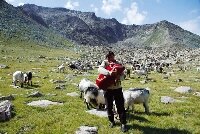
Time For to Discover the Black Sea Highlands
Discover the Black Sea
highlands in September when time is suddenly
rent by a blanket of fog or the cry of a
vulture, and make the acquaintance of nature in
its most beautiful aspect.

Formation of the First Greek Settlements in the
Pontos
According to Liddell and Scott’s An Intermediate
Greek-English Lexicon, the word Pontos stands
for the sea, especially the open sea. In time,
the word Pontos became associated with the
north-eastern portion of Asia Minor that borders
the Black Sea (see Map 1).1 The Greeks first
called the Black Sea, Aξεινος πóντος
(inhospitable, unfriendly pontos), but later it
was called Εϋξεινος πóντος (hospitable pontos)
when they became aware of its wealth in the
lands around it ...

Crypto-Christians of the Trabzon Region
of Pontos
The crypto-Christians (also called cryphi,
klosti, Stavriotes, Kromledes) were Christian
Greeks who due to the Muslim persecution against
Christians publicly declared themselves Muslims.
However, in secret, they upheld their Greek
language, customs and Christian religious
practices... |
|
|
| |
|
|
The Incredible
Odyssey of the Black Sea Greeks
Neal Ascherson

Pontic refugee
family, Greece
The Black Sea Greeks are, according to one scholar, "perhaps the
most astonishing of all survivors." Three thousand years ago they
left their homes in ancient Greece to cultivate the fertile land
that borders the Black Sea. Since then, they've seen it all: Roman
rulers, Byzantine emperors, Crusaders, Ottoman overlords, and Soviet
hegemony. Neal Ascherson, in an excerpt from his exceptional new
book, Black Sea, tells the riveting story of this fascinating
people.
The bus journey from Ankara to Trabzon, which used to be Trebizond,
takes thirteen hours. The road begins in the steppe of central
Anatolia and then winds down through the forests and passes of the
coastal mountains to the Black Sea. This is the route that Xenophon
and his Ten Thousand took in 400 BC, on their march home from
Persia. But where exactly they were when the soldiers saw the blue
band on the horizon ahead of them, and cried out "Thalassa! The
sea!," cannot be known.
Some think that it was near the port of Ordu, about a hundred miles
west of Trebizond, others that they filed down from the mountains a
little further east. The point is that when the soldiers shouted "Thalassa!,"
the local people understood them. They were Greeks too. Trebizond,
which was their "Trapezos," was only one of the chain of
colony-cities which lined that shore, in touch with all the other
Greek settlements ringing the Black Sea. They had been there for
three hundred years already when Xenophon and the survivors of his
army came out of the wilderness. The Pontic Greeks, as these
settlers came to be called, remained on that coast and in its green,
foggy valleys running up to the snowline for almost
two-and-a-half-thousand more years. They were ruled by the Romans,
then by the Byzantine emperors, then-briefly-by the Grand Comnenoi,
emperors of Trebizond. After that, the Turks came. That too the
Pontic Greeks survived, negotiating and conceding a little,
converting to Islam a little. The end came only in 1923, with the
event known in diplomatic language as "The Exchange" and in
undiplomatic Greek as the Katastrofe.
Greece, in a wild imperial venture supported by Britain, had invaded
western Anatolia, hoping to make itself an Aegean "great power" and
to construct a "greater Greece" out of the ruins of the Ottoman
Empire. But the invasion ended not simply in Greece's defeat at the
battle of Dumlupinar in 1922, but in a calamitous rout and slaughter
which drove not only the Greek armies but much of the Greek civilian
population of Anatolia into the sea. The Treaty of Lausanne, in
1923, settled the frontiers of the new Turkey under the leadership
of Mustafa Kemal Ataturk. The universal caliphate-a sprawling,
multi-ethnic and multi-religious empire-now imploded like a dead
star, metamorphosing itself into a compact, homogenous modern state
of Moslem religion and Turkish speech. At the same time, Greece and
Turkey agreed to exchange minorities. Nearly half a million Moslems
(many of whom were Greeks in all but religion) were forced to leave
Greece, while more than a million Christians (some of who were
culturally Turks) were expelled from Turkey. Most of the Christians
were Pontic Greeks, who abandoned their monasteries and farms, their
town houses and banks and schools, and fled with what they could
carry down to the docks…
Trabzon is built upon ridges, between deep ravines which run down to
the sea. On one of these ridges stands the ruined citadel of
Trebizond, the palace and fortress of the Great Comnenoi. The town
itself is full of Byzantine churches which are now mosques: St.
Eugenius, St. Anne, St. Andrew, St. Michael, St. Philip, the cave
church of St. Savas, the church of Panaghia Chrysocephalos. On a
headland in the western part of the city, cool in the wind from the
sea, is the cathedral of Aghia Sofia, now a museum, its Byzantine
frescoes restored by David Talbot-Rice and Edinburgh University.
The Comnenian Empire began here in 1204, after the Crusaders had
stormed and sacked
Constantinople; Alexis Comnenos, son of the
Byzantine emperor, escaped to Trebizond and made it his capital. A
stroke of commercial luck ensured that the Comnenian state would
survive and flourish even after the Greek emperors had regained the
throne at Constantinople. In the mid-thirteenth century, the Mongol
conquest of Persia opened a new, southern branch of the "Silk
Routes" which began at Tabriz and ended, after crossing the Pontic
Mountains, at Trebizond.
Professor Anthony Bryer, who in our own times is the
historiographer-imperial of the Comnenoi, lays emphasis on the
compactness of this Pontos which was governed from Trebizond,
"hemmed like the Lebanon and south Caspian by its Alps...select by
climate and geography." Coastal agriculture, once oil, wine and
grain but now nuts, tea and tobacco, is fringed with temperate rain
forests "which give way to summer pastures, overlooking the dry
highlands of Armenia, upon which the Pontos turns its back to face
the Black Sea."
From the beginning, the Greek settlement here was unlike those on
the other Black Sea coasts. It was a settlement in depth, reaching
up into the wooded valleys of the interior. Behind the usual
city-colonies along the shore, "Greek-speaking settlement extended
inland to the watershed." In the time of the Comnenoi, the
relatively tiny city of Trebizond enjoyed a turbulent urban and
political life, but the mass of the population lived in the hills
behind, growing crops and driving their beasts up to high pastures
in summer. Most of these Christian peasants were the tenantry of a
chain of opulently endowed monasteries which perched along the steep
flanks of the valleys; as Bryer says, "a monastic economy of almost
Tibetan proportions."
Apart from the cities, this rural Pontic society amounted to far the
greatest concentration of Greek-speaking population in the Hellenic
or Byzantine worlds-much more numerous than that of the Peloponnese.
Constantinople finally fell to Mehmet the Conqueror in 1453, and
Trebizond was captured by the Turks in 1461 after a siege of
forty-two days. But the Pontic Greeks remained in their valleys and
villages, and the monasteries clung to their wealth and most of
their estates for many more centuries. Many people, including some
of the great families of Trebizond, converted in a superficial way
to Islam, but continued to speak Pontic Greek-a language which over
the millennia had steadily diverged from the tongue spoken in the
Aegean or in the capital of the Byzantine Empire.
Who did they think they were, in this pre-nationalist age? In the
first place, they did not think of themselves as "Greek" or as a
people in some way rooted in the peninsula and islands we now call
"Greece." Sophisticates in Trebizond might address one another in
the fifteenth century as "Hellenes," but this was a cultural fancy
rather than an ethnic description. Outsiders, whether Turks or
northern Europeans, referred to them and to all the inhabitants of
the Byzantine Empire as "Rom" or "Rum" people, or as
"Romanians"-citizens of the Roman Empire, in other words, who were
also distinguished by their Orthodox Christian faith. Struggling
with these categories, a Pontic Turk whose village had once been
Greek told Anthony Bryer: "This is Roman (Rum) country; they spoke
Christian here..."
The people of the Pontic valleys and cities themselves seemed to
find identity in three things: in belonging to a place or patris
which could be as small as a village, in not being Western (Roman
Catholic) Christians, and in feeling themselves to be members of a
polity which was so ancient, so sacred and superior to all others
that it scarcely required a name. We call this community, weakly
enough, "the Eastern Empire," or "Byzantium." That cannot convey the
almost Chinese degree of significance which the "Rom" people
attached to the Empire even long after it had been overthrown, as if
it were the eternal essence of all political community in comparison
to which other states and realms were only transient realities.
We call the imperial capital Constantinople or Byzantium; the
Vikings called it Micklegard; the Turks called it
Istanbul, which is
no more than the three Greek words eis tin polin-"into the City."
And for its citizens, whether they lived within its walls or in
Pontus or Georgia or Crimea or at the Danube mouths, that was its
name: "The City." There was no other. Nor was it possible that this
city could come to an end except in a purely phenomenal way. The
essence was indestructible. Inevitably, its earthly manifestation
would return.
This is a Pontic folk-song composed 500 years ago, when the news of
the fall of Constantinople reached Trebizond:
A bird, a good bird, left the City,
it settled neither in vineyards nor in orchards,
it came to settle on the castle of the Sun.
It shook one wing, drenched in blood,
it shook the other wing, it had a written paper.
Now it reads, now it cries, now it beats its breast.
‘Woe is us, woe is us, Romania is taken.'
The churches lament, the monasteries weep,
and St. John Chrysostom weeps, he beats his breast.
Weep not, weep not, St. John, and beat not your breast.
Romania has passed away, Romania is taken.
Even if Romania has passed away, it will flower and
bear fruit again…
The Turkish guide-books on sale in the Taksim Meydane offer this
account of the 1923 Katastrofe: "After the proclamation of the
Republic, the Greeks who lived in the region returned to their own
country, and the monastery of
Sumela was evacuated and abandoned."
Their own country? Returned? They had lived in the Pontos for nearly
three thousand years. Their Pontic dialect was not understandable to
twentieth-century Athenians. Their world was the Black Sea littoral,
and their family connections abroad, by the twentieth century, were
with the enormous Pontic Greek emigration which had already settled
in the Russian Empire: in the Caucasus, Crimea, and the lands around
the Sea of Azov.
Yet the guide-books are not entirely wrong. All through the
nineteenth century, two historical forces worked on the antique
community of the Pontic Greeks with growing intensity: an ideology
and a practicality. One was Greek nationalism, radiating from
Constantinople and then from
Athens, at once modernising and
romantic. The other was the rise of Russian power around the Black
Sea, and the successive wars which advanced Russia into the Balkans
in the West and down into the coastal regions of the Caucasus in the
East. Each war, increasing the tensions between Christians and the
Ottoman authorities in Anatolia, led to an inflow of Moslem
refugees, mostly from the Caucasus, into the Pontos. After the
Russian-Turkish war of 1828-9, some 42,000 Greeks, almost a fifth of
the Pontic population, followed the withdrawing Russian armies. More
Greeks left after the Crimean War, settling mainly in Georgia and
Crimea, and another emigration took place after the 1877-8 war
between Russia and Turkey, until by about 1880 nearly 100,000 Greeks
had taken refuge under the Christian protection of the tsar. The
last of these movements took place during the First World War.
Russian troops advancing along the south coast of the Black Sea
occupied Trebizond for two years, between 1916 and 1918, and when
they withdrew another 80,000 Greeks departed with them, fearing
reprisals.
The "Pontic Renaissance," by contrast, came from the West. All round
the Black Sea, the Greek communities flung themselves into the huge
commercial opportunities of the nineteenth century, into shipping,
banking, tobacco-growing and the manufacturing industry. They used
their prosperity not only for investment but for enlightenment and
culture. George Maraslis, for example, whose family came from
Plovdiv in modern Bulgaria, was mayor of Odessa from 1897 to 1907;
with his personal wealth, he founded schools, libraries, publishing
houses and teacher-training colleges not only in Odessa but in
Thrace, Plovdiv ("Phillipoupolis"), Salonica, Corfu and Athens.
Trebizond shared this prosperity, especially during the decades when
the port served as the western terminal of the overland route from
India through Persia (the boom ceased abruptly when the Suez Canal
was opened in 1869). There were European consulates in the city, and
half a dozen Greek banks. The whole Pontos benefited from a surge of
school-foundation, and with modern education came an entirely new,
lay generation of teachers trained in Constantinople or Athens for
whom the Greek language was not Pontic but classical.
For the first time, intellectuals set out to give the Pontians an
ethnic national consciousness. That required "origins" and "roots."
Anthony Bryer relates how "Triantaphyllides, a Chaldian
schoolmaster...christened his son Pericles and sent him to Athens,
whence he returned after 1842 to teach Xenophon and classical Greek
at the Trebizond Phrontisterion..." By 1846, schoolmasters had
renamed Gümüshane a fancy "Argyropolis." In a typical example of
cultural nation-invention, the teachers proceeded to graft the
Pontos onto the stock not just of Byzantium but of Periclean Athens
itself. All round the Greek world of the Black Sea, the same process
was going on. The teachers and the school curricula came from
Athens, bringing with them a new concept of Greekness which linked
the Greek-Orthodox communities of the Black Sea and the "nation" of
Greece.
This was in no way a "Little Greece" nationalism restricted to the
arid peninsula in the Aegean Sea. A speaker in the Greek parliament
in 1844 expounded this newly designed identity: "The Kingdom of
Greece is not Greece. It constitutes only one part, the smallest and
the poorest.... A Greek is not only a man who lives within the
Kingdom, but also one who lives in Yoannina, Serrai, Adrianople,
Constantinople, Smyrna, Trebizond, Crete and in any land associated
with Greek history and the Greek race... There are two main centres
of Hellenism: Athens, the capital of the Greek Kingdom, and the
City, reaching from Athens to the borders of Georgia and Ukraine."
But "The Great Idea" had now acquired a far more impressive myth of
origin, which led back to the Parthenon and the stoa and the battle
of Marathon.
This is why, in 1923, it was possible for Chrysanthos, last
Metropolitan of Trebizond, to lead 164,000 Pontic Greeks "home" to
Greece-a country alien to them physically, climatically, politically
and linguistically. By then, admittedly, there was nowhere else for
them to go. The Russian Empire had become the Soviet Union,
suspicious of Greeks ever since a disastrous occupation of Odessa
and Sevastopol by the Greek Army in 1919. Georgia, where hundreds of
thousands of Pontic Greeks had settled, had become an independent
state after the Russian Revolution but had been reconquered by the
Bolsheviks. Attempts at the Versailles Peace Conference to gain
international support for an independent "Pontic Republic," or for
an Armenian state in
Asia Minor which would include Trebizond and
give the Pontic Greeks internal autonomy, had come to nothing.
The Greek invasion of Anatolia, egged on by Lloyd George, was
smashed by Kemal Ataturk in 1922. The following year brought the
Treaty of Lausanne, and the "exchange" of Moslem and Christian
minorities. The Greeks of Istanbul and the Aegean islands west of
the Dardanelles were allowed to remain for another half-century,
until most of the surviving Greeks left during the Greco-Turkish
confrontation over
Cyprus after 1974. "The Great Idea" was extinct
at last…
But the Pontic Greeks were not extinct at all. From being a
motherland with widely scattered children, the Pontos had become a
diaspora. One part of the diaspora now made its life in Greece,
remaining for other Greek citizens a puzzling, inward-looking
nation-within-the-nation. The other part vanished behind the
fortress walls of the Soviet Union and the outside world, including
most Greeks, forgot about them. But they, it turned out, did not
forget about Pontos or Greece.
Most Greeks in the new Soviet Union lived around the Black Sea.
Settlers who concentrated around the north shores of the Sea of Azov
(the "Mariupol Greeks") had a dialect and culture of their own; they
were the descendants of an older farming community in Crimea which
Catherine the Great had moved into southern Russia. But the majority
was of Pontic origin. The Greeks lived in the port cities,
especially Odessa, Rostov and Sevastopol, in the fertile Kuban
steppes, in the coastal towns and villages of Georgia and Abkhazia
and in the hills off central Georgia.
The first Soviet years were tolerable, even encouraging. The Greeks
rapidly recovered from the devastations of the Civil War. They kept
most of their farms, and there was a vigorous cultural revival: a
reform of the Greek alphabet; a wealth of bold and interesting Greek
books, journals and newspapers in the kiosks; a state-assisted
network of Greek-language education. On the Kuban coast and in some
districts of Ukraine, Greek autonomous regions were established.
But with the collectivisation of farming after 1928, and Stalin's
usurpation of supreme power, the Greeks were transformed almost
overnight from beneficiaries of the Revolution to victims.
Everything about them was now construed as counter-revolutionary:
their tradition of free enterprise, their links with the
"imperialist" world outside and especially with Athens (many of them
held Greek passports), their independent culture. The Greeks in
south Russia and Ukraine strongly resisted the loss of their farms,
and thousands were arrested. As the "Great Purges" developed in the
1930s, their cultural and political leaders were charged with
treachery or Trotskyism and murdered. The Greek schools were closed
and Greek literature destroyed. In south Russia, political
persecution rapidly turned into ethnic pogroms; entire Greek
communities were arrested and deported. Dr. Effie Voutira, who has
done much research among the Pontic Greeks in the ex-Soviet Union,
estimates that as many as 170,000 Greeks were expelled to Siberia
and Central Asia after 1936.
But this had only been a prelude. The full impact of state terror
was turned against the Greeks in the aftermath of the Second World
War. Like the Crimean Tartars, the Chechens and the Volga Germans,
the Greeks of the Soviet Union became a condemned nationality and
were banished.
The 70,000 Crimean Greeks, almost all Pontic by descent, went first.
Then came the Greeks of Kuban and south Russia. Finally, on the
night of 14/15 June 1949, a single immense operation planned in
secret for many months rounded up almost the entire Greek population
of the Caucasus.
The settlements in Abkhazia and along the Georgian coast down to the
Turkish frontier were the principal target. About 100,000 people
were seized. Their villages were surrounded in darkness by NKVD
special troops, and they were given only a few hours to pack. Many
of them perished on the sealed trains, and when they arrived at
their destination-usually weeks later-they were deliberately
dispersed: scattered among small Moslem communities and kolkhoz
cotton farms across the Central Asian plains.
Why was this done? There is no clear answer, even today. Stalin's
fear of war in the Black Sea, his memories of the 1919 Intervention,
Georgian intrigue and envy or the possession of Greek passports by
so many Pontic Greeks-all these have been put forward as
explanations. Perhaps the real provocation was that the Greeks were
a family. Their human links were stronger than the artificial bonds
of totalitarian politics. They were residents of the Soviet Union,
but their crime was to be "cosmopolitan"; to be members of a wider
world of trade, gossip, marriages and family funerals which carried
on its activities across and beyond the Soviet frontiers.
But Black Sea life without Greeks-the local politicians and factory
owners, the grocers and cafe proprietors, the journalists and
bank-clerks and grain-dealers and ship's captains-was a thin shadow
of what it had once been. The Greeks had been envied by their
neighbours. Now they were painfully missed…
Like the Crimean Tatars whose exile they shared, the Pontic Greeks
in the Soviet Union did not merely sit down and weep by the waters
of Babylon. They tried, illegally and in secret, to teach Pontic
Greek to their children, who at school were being indoctrinated into
a monoglot Russian-Soviet culture. In the dusty kolkhoz villages of
Kazakhstan and Uzbekistan, parents managed to transmit at least
fragments of their culture-music and cookery, especially. At the
same time, their sense of identity slowly changed and hardened
during the decades in Central Asia. Although they had now lost
contact not only with Athens but with the remnants of the old Greek
diaspora around the Black Sea many thousands of miles away to the
West, their sense of "Greekness" tightened into a belief in their
own Greek political identity.
Most of the Pontic Greeks who went into exile had retained Greek
passports. After the First World War, the government in Athens had
distributed national identity papers throughout the diaspora, a
gesture which paid respect to the dying, irredentist "Great Idea."
At the same time, it was in line with a new current in post-1918
nationalism: the notion that nation-states had a right and even a
duty to extend some degree of membership to their own ethnic
compatriots abroad. Cultural affinity was to be developed into
political affiliation. This idea was taken up principally by nations
with a tradition of emigration and a recognizable diaspora. Germany,
Ireland and finally Israel were among the nation-states which
constructed versions of a "right to return," the right to
citizenship based on ethnic criteria which could be biological,
religious, cultural or a mixture of all of them. Poland, before and
after the Second World War, experimented with several versions of "Polonia,"
a category which was intended above all to tap the wealth of the
huge Polish diaspora in the United States.
What did this call to identification with a "motherland" really
mean? The contemporary states of Greece, Ireland, Israel, Hungary
and Poland are all modern restorations of lost polities. As
restorations, they are all highly inaccurate; none of them has the
frontiers of its "original." But those originals all had in common
the fact that they were obliterated from the political atlas by
imperial violence. Accordingly, those who left the old national
territory as emigrants-mostly in the nineteenth century-retained and
passed down some sense that their departure from their native
countries had been a matter of coercion rather than of free choice.
The resurrection of these countries as independent nation-states was
therefore at once touching and reassuring to a diaspora. It was
emotionally touching because independence did not merely avenge the
trauma of emigration but also legitimated it. In a country like the
United States, the appearance of Ireland or Poland on the world
stage as a fully fledged, passport-issuing, conference-attending
state raised the self-esteem of the Boston Irish or the Chicago
Poles. The whole rhetoric of triumphant national liberation ascribed
the tragedies of the past to foreign imperial oppression. "We did
not run away from our country in its hour of need. We were driven
overseas by English landlords, or Prussian gendarmes, or tsarist
Cossacks."
And it was reassuring to the diaspora because it demanded little of
the emigrant. There could of course be strong moral pressure to
"return"-intense in the case of Zionism, perfunctory in the cases of
Ireland or Poland. But for the most part the emigrant could both
have his cake and eat it. He or she could remain in the relative
comforts of Chicago, New York or Melbourne with the extra
sentimental empowerment of a second passport and a flag to carry on
the old country's independence day parade.
At the same time, the cultural gap between the diaspora and
"homeland" could widen very rapidly indeed. Less than two centuries
have been enough to make the average Illinois Pole into a foreigner
in Warsaw, where, if he speaks Polish at all, he usually baffles his
listeners with remnants of extinct peasant dialect. In Budapest, the
Szekelyi women from Transylvania, wearing peasant costume and
selling embroidered linens in the underpasses, are not exactly
emigrants-their country left them, when Hungary lost Transylvania to
Romania, rather than the other way round-but their culture is now
remote from that of late twentieth-century Magyars. The German
Einsiedler, now arriving in the Federal Republic after hundreds of
years of village life in Eastern Europe, Ukraine, Russia and
Siberia, often speak little or no German and bring with them an idea
of Germany-pious, servile to authority, repressive-which was already
obsolete when Bismarck was chancellor.
Two different processes operate here, apparently contradictory but
actually complementary. As the cultural gap widens, so the
subjective importance of national identity-in the narrow sense of
nation-state membership-intensifies. This new diaspora patriotism
may remain little more than a luxury of the imagination, but there
are times when, suddenly and desperately, these cheques on the Bank
of Symbolism are presented for payment. We have been living through
such times for 50 years. Twentieth-century anti-Semitism in Europe,
followed by the rise of Arab nationalism, brought the Jews of Europe
and the Middle East to Israel. As the Soviet dictatorship weakened,
the Volga Germans (also deported by Stalin to Central Asia) set out
for Germany announcing that they were ‘‘returning home."
The Pontic Greeks were doing the same thing. Perhaps 300,000 are
left in the territories of the old Soviet Union, more than half in
Kazakhstan and Uzbekistan. Most now intend to "return home," and
nearly 200,000 have already done so in the last few years. And by
"home," they mean modern Greece.
Even Zionist Jews cannot match the extravagance of this statement,
as a remark about history. It is nearly 3,000 years since the first
Greek colonists passed through the Bosporus and set up trading-posts
around the Black Sea. Most of them originated from Ionian cities, on
the Aegean coast of what is now Turkey, rather than from the
Peloponnese. Since then, their culture and language have steadily
diverged from those of the peninsula we call "Greece." And yet now
their descendants head for Athens or Salonica as if it were the most
natural thing in the world.
After Stalin's death in 1953, the deported Greeks who had acquired
Soviet nationality were allowed to return from Central Asia. (Most
went back to Georgia, although their houses and farms had been sold
off or confiscated after 1949.) The rest, those who held Greek
papers issued by a country which they had never seen, remained in
exile. At this stage, it seems, their concept of their status and of
their relationship to Greece began to change. They had accepted
their first great uprooting, the flight from the Turks in Pontos, as
an emigration, a move to new shores on the same sea. But Stalin's
banishment turned the Pontic Greeks, in their own estimation, into
refugees.
Dr. Effie Voutira has pointed out that the modern use of the word
"refugee"-especially in English-predicates the existence of a
nation-state. By the mid-twentieth century, everyone was assumed to
be a member of a national community. Everyone was at home somewhere,
each with his or her passport. The great and growing number of human
beings who had become internationally "homeless"-the refugees-were
therefore people whose primary plight was that they had been
separated from their rightful nation-state. This is why we almost
always add a national adjective to the term, as in "Bosnian/Polish/Zairean
refugee." The refugee is somebody who once had a nation, but lost
it.
This is an odd, inadequate way of designating the millions of
displaced individuals and families carried back and forth on the
tides of the world, but the displaced themselves are increasingly
inclined to adopt it-precisely because "refugee" implies membership
of a state community. This was not always so. The Gaelic-speaking
Highlanders who were removed from their townships and transported to
Canada considered themselves emigrants, rather than refugees,
although their departure (the "Highland Clearances") was not usually
voluntary. The Pontic Greeks who fled from Trebizond to run beach
cafes at Sukhum, or print newspapers in Odessa, or plant vineyards
in Georgia, grieved for their lost homes but prepared to put down
fresh roots. But when Stalin snatched them away from the Black Sea
and duped them in the steppes of Central Asia, threatening their
whole community with physical and cultural extinction, they could no
longer consider themselves emigrants. This time, they had been not
merely transplanted but condemned.
In Central Asia, the Pontic Greeks faced two extreme alternatives.
One was to assimilate to Soviet society, and to seek to climb the
Party ladder-which many Greeks did. The other was to reject the
whole new environment. In the end, the choice was effaced. The
Communist Party and then the Soviet Union capsized and sank, leaving
climbers and rejectors together in the same leaky boat: all were now
non-Kazakh or non-Uzbek "colonialists" in newly independent Moslem
states. The "natives," who understandably drew no distinction
between outsiders who had arrived in their land as conquerors,
imperial settlers or banished victims, contemplated the farms and
bureaucratic posts occupied by Russians, Ukrainians, Crimean Tatars,
Greeks, Volga Germans, Chechens and Meshketian Turks, and began to
close in. By 1990, ethnic rioting between locals and incomers was
spreading across Central Asian republics. Now, with fresh
desperation, the Pontic Greeks appealed to "their nation:" Greece.
In the first years after the Russian Revolution there had been some
outflow to Greece, and more Greeks contrived to escape in 1939-9,
after the Great Purges. But then the Soviet external frontiers
closed tightly. They did not open again for almost fifty years, when
Mikhail Gorbachev began to lift the ban on mass emigration.
At that time, in the mid-1980s, probably around 500,000 Greeks were
living in the Soviet Union, almost all of them of Pontic origin. By
the end of the decade, they were arriving in Greece at the rate of
20,000 a year, and by the mid-1990s, the Greek villages in Central
Asia were practically empty. Some, a minority, went back to the
Black Sea coasts in south Russia or Georgia. There was even some
optimistic talk of reviving the old idea of a Greek autonomous
region in the Kuban; a congress of Greek delegates was held at
Gelendzhik, near Novorossisk, in 1991, and a Greek-language
newspaper (Pontos) appeared in the little port of Anapa. But the
Caucasus grew much less attractive for Greek exiles in the next few
years. Civil war in Georgia was followed by an even more violent
struggle as Abkhazia, historically one of the centers of Greek
settlement, fought Georgia for its own independence. Most Pontic
Greeks headed "home"-to Athens or Salonica…
As Anthony Bryer writes: "Pontic Greeks...will not lie down. They
are perhaps the most astonishing of all survivors. But some seek a
history, some seek a homeland, and some both." It is not surprising
that modern Greeks often feel baffled by the contradictions of
Pontic attitudes. On the one hand, they have opted for Greece as
"home," but then-as soon as they have disembarked in the promised
land-they begin to weave together a wonderful, exotic bower of
special tradition and private destiny which suggests that their home
is, after all, entirely elsewhere. Their emblem is the Pontic eagle
or the Byzantine peacock, perhaps the "good bird" which flew from
the City to proclaim that "Romania is taken." Their slogan is the
last line of that song: the proclamation that dead Romania will
"flower and bear fruit again."…
The good bird mourns and prophecies again, but what will be the
flowers and fruit? Once this tree of Romania, felled but rising
magically from death to blossom once more, seemed to be a version of
"The Great Idea": the restoration of the City's imperium over all
the lands and coasts of Byzantine Christianity. But now "Romania"
seems to have retreated into itself, contracting-rather like the
modern Turkish state-from a universal realm into an ethnic
defensiveness concerned with a single tradition and a single
language. "Romania" seems to have become less a kingdom of this
world than the secret garden of those who keep faith with the past.
The bird sings that, one day, the glory and pre-eminence of the
Pontic Greeks will be recognised wherever Greek is spoken. When that
day of justification comes, the two-and-a-half millennia of Anabasis
will at last be over. The theater of transformations which made this
people first colonists, then strangers in their own land, then
emigrants, then exiles and then refugees will lower its curtain. The
journey which led from the Ionian shore to Pontos, from Pontos to
Crimea and Kuban and the Caucasus, from the Black Sea to the nomad
steppes of Central Asia and finally from Kazakhstan to Greece, will
be complete.
Usefull links
TRABZON GREEK: A LANGUAGE
WITHOUT A TONGUE by Ömer Asan
Sumela Monastery
Kemenche
TRADITIONAL PONTIC
DANCES ACCOMPANIED BY THE PONTIC LYRA
The cost of
language, Pontiaka trebizond Greek
Colchis, Armenia, Iberia,
Albania
Eastern Black Sea
houses, Turkey
Greek Penetration
of the Black Sea 1
Greek Penetration of the Black Sea
2
Greek Penetration of the Black Sea
3 Greek Penetration of the
Black Sea 4
A Pontic Greek History by Sam
Topalidis
|
|
| |