THE LAND:
Ancient Pontus
Not very long ago on the geological time scale, the Anatolian
landmass started a slow and inexorable movement to the north. An
old, flat continent, part of which now forms southern Russia, stood
in its path; it caved in and sank under the pressure. The waters of
the Mediterranean rushed in over the Thracian Peninsula to fill up
the void, forming the great inland se a known as the
Black Sea-the
Pontus Euxinus of ancients.
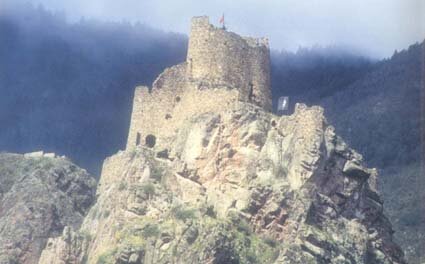
A massive line of mountains-the Pontic Alps of
Turkey's northern coast-sprang up along the line of impact, forming
a natural wall that defines the southern rim of the sea.
The tectonic history accounts for several unusual features of the
sea and the lands that surround it. The Black Sea is a geographical
extension of the broad flatlands of eastern Europe, fully exposed
on its smooth, gently sloping northern (Balkan and Russian) side,
where the Danube, the Dnicpr and the Don bring in the waters of the
enormously wide and wet east European basin. This excess of water
creates a surface layer of very low salinity and a strong outflow
through the Bosphorus and the Dardanelles-the narrow straits which
connect the Black Sea with the Mediterranean. Underneath this thin
upper layer flushed out through the straits, the antediluvian waters
of the Black Sea lie undisturbed: they are saturated with the
noxious gases produced by the disintegration of the flora of
archaic times. and are
so salty that few forms of life subsist in them below a depth of 200
meters (650 feet).
Above the surface, northerly and westerly winds predominate. They
sweep over the sea, gathering moisture along the way until
intercepted by the great natural barrier of the Pontic Mountains.
That is where they deposit their load. The northern coast is bright
and sunny; Odessa and Yalta are quasi-Mediterranean sea resorts. The
south, by contrast, is more easily compared with the shores of
America's Pacific Northwest or southwestern Norway. The mountains
are almost permanently cloudy and receive immense amounts of rain.
Climate shapes the environment: nature runs amok; waterfalls and
wild streams burst out of every clearing in the forest; fence poles
take root and sprout leaves.

The Pontic Alps are young mountains, born at the same time as their
European namesakes, with contours that have not yet settled into the
placidity of geological middle age. They rise straight from the
seabed at a depth of over 2000 meters to an average height of 3000
meters within a short distance inland. They increase in height and
steepness in the east, where they press against the Caucasus Massif
in the north. At the eastern edge, the permanently
snow-capped peaks of the Tatos-Kaçkar Range soar to an altitude just
short of 4000 meters. The "elbow" formed between them and the
Caucasus enjoys the climate of a natural greenhouse. Temperatures
are moderate, but vegetation takes on the character of a
subtropical rain forest, with wild undergrowth, giant creepers and
mossy beards hanging from majestic trees. Warm climate products like
tea, citrus fruit and bananas grow in abundance.
This landscape is radically different from the sun-drenched maquis
and arid steppe that one usually associates with the rest of Turkey.
Except for the relatively
low middle section around Samsun. the Pontic Alps rarely allow the
humid winds to penetrate the Anatolian landmass and deliver the rain
that would otherwise green the interior. This is most strikingly
observed at any one of the eight road passes that cross the
mountains east of Samsun at altitudes of 2000 to 2600 meters each.
At the very top, the scenery changes abruptly from one of lush
abun¬dance into one more easily associated with the wastelands of
Inner Asia. This sudden transition constitutes one of the most
memorable images of any Black Sea Journey.

The transition also works in another
way: just as the mountains block the humid winds of the north, so
throughout the ages they have acted as a barrier against the
historical currents that affected the lands to the south. While
classical civilization flourished in the Mediterranean basin and
great cultures rose and fell in the Anatolian interior, the Black
Sea coast remained mostly untouched-an isolated and unique region
with its own separate history and distinct amalgam of people.
links
Black Sea,
Colchis
serander
Eastern
Black Sea houses
Greek Penetration of the Black Sea
Hemsin folk
architecture
Maçka and
Sumela monastery travel
NATURE SPORTS IN
KACKAR MOUNTAINS, TURKEY
LINKS How
to get there Gow to get t oTurkey?
How to
get around in Turkey?
When to go to
Turkey?
What to
bring to Turkey?
What to
read for Turkey travel?
Background
Turkey
What to see
in Turkey travel?
How to plan
it?
Where to
stay in Black Sea region Turkey travel?
Turkish language
some usefull words in Turkey travel
Place names
in turkey
More info
More about
Turkish language
Job
Search in Turkey
Short History of Turkey
The Communications in Turkey
Real
Estate in Turkey
Insurance
in Turkey
Ankara
Travel guide
Izmir
Travel guide Izmir Travel tips
|