Sinop travel
situated on a narrow peninsula at Turkey’s
northernmost point, Sinop is like a Black Sea
island with its good-natured people and streets
where time passes slowly.

Development of the Pontic Greek Dialect
Will Pontic Greek continue to be spoken? Bortone
(2009) believes Pontic Greek spoken in the
Pontos in Asia Minor today will probably
disappear. The challenge is to keep the Pontic
Greek dialect alive. The more recent work of
researchers like Emeritus Professor Peter
Mackridge, Assistant Professor Pietro Bortone,
Dr Theofanis Malkidis, Ömer Asan, Dr Anthi
Revithiadou and Dr Vassilios Spyropoulos have
increased our knowledge of the dialect.
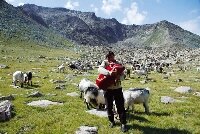
Time For to Discover the Black Sea Highlands
Discover the Black Sea
highlands in September when time is suddenly
rent by a blanket of fog or the cry of a
vulture, and make the acquaintance of nature in
its most beautiful aspect.

Formation of the First Greek Settlements in the
Pontos
According to Liddell and Scott’s An Intermediate
Greek-English Lexicon, the word Pontos stands
for the sea, especially the open sea. In time,
the word Pontos became associated with the
north-eastern portion of Asia Minor that borders
the Black Sea (see Map 1).1 The Greeks first
called the Black Sea, Aξεινος πóντος
(inhospitable, unfriendly pontos), but later it
was called Εϋξεινος πóντος (hospitable pontos)
when they became aware of its wealth in the
lands around it ...

Crypto-Christians of the Trabzon Region
of Pontos
The crypto-Christians (also called cryphi,
klosti, Stavriotes, Kromledes) were Christian
Greeks who due to the Muslim persecution against
Christians publicly declared themselves Muslims.
However, in secret, they upheld their Greek
language, customs and Christian religious
practices... |
|
Travel to Black Sea’s blue and
the mountains’ green and Turkish wedding

From Amasra to Zümrüt
Köy
Road to a wedding
Tingling with anticipation, we follow the
colors of the rainbow along the Küre Mountain
range east from Amasra on the Black Sea coast,
wedding invitation in hand.
ARTICLE-PHOTO: FARUK ÜRÜNDÜL
Judging by the exuberance
that surrounds us all along the road, we are not
the only ones invited. Obviously the Black Sea’s
blue and the mountains’ green also number among
the invited guests. A mismatch between
expectation and reality has dogged us ever since
we set out. Every hill conceals a blue-green
gorge. The majestic Black Sea mountains on one
side, a placid sea breeze on the other. The vast
blue sea batters the rock gates of Gideros Cove.
Powerful white-crested waves pound the verdure
along the shore. The white cries of two gulls
pierce the white clouds. The voices of children
playing at the top of the hill mingle with the
putt-putt of a fisherman’s motorboat. Despite
all the commotion, however, tranquility reigns
at Gideros Cove.

There is a small beach on the western shore with
a couple of restaurants at its eastern end.
Humble kitchens, crammed into the corners of
everyday life and proffering unexpected natural
flavors instead of the usual over-priced
’boutique’ tastes. The fried red mullet and
pickle-and-bean salad are quite famous. We
ourselves hanker after fresh anchovies, dipped
in cornmeal and fried in hot oil.

FROM GİDEROS TO CİDE
With the taste of Gideros still on our palates,
this time we encounter Cide. Spread along its
extensive beach, the sea displays its myriad
gifts from afar. Had it been summer, we could
have pitched a tent on the shore. After Cide we
head for the mountains and the
Şenpazar-Azdavay-Pınarbaşı road. The driver’s
job isn’t easy. The biggest hazard is the
landscape since it’s hard to take your eyes off
it. Your glance inevitably strays to the cloud
mass caught between the mountains, the
traditional wooden houses, the people toiling on
the steep slopes. Finally we come to Küre
Mountain National Park (KDMP), Europe’s oldest
natural forest. It should not be forgotten that
109 of the 675 plants, 40 of the 132 mammals
(which include endangered species such as lynx,
otter and deer) and 129 of the 454 species of
bird found here enjoy the distinction of being
endemic to the region. The park more than
deserves its epithet, ‘Wild Paradise'.
SPOON MAKERS AND BOX TREES
We delve into a village where we admire the
stately plane trees and old wooden houses,
almost obscured from the road. This region is
famous for its spoons carved from boxwood. At
the mere mention of the word ‘spoon', we are
immediately directed to a spoon maker. In the
village of Harmangeriş we become their guests,
and a place we just happened to stop in passing
is quickly transformed into a tea party with
honey and walnuts and an extended chat. Spoon
making is passed down from father to son. They
would like to stop using boxwood, which is
becoming extinct, but at the same time they are
well aware that the spoons come in handy and
look good in the kitchen. Although they have
begun using beech, they are wondering how they
will ever give up box, which shows off their
efforts and skill to better effect. Wishing we
could chat longer, we hit the road again. The
boxwood spoon makers also tell us about a
shortcut, so we take the turnoff for Azdavay
before the bridge just beyond the village of
Deretekeli.
RED, ORANGE AND PURPLE DREAMLAND
To the beautiful wooden houses are added the
village women and young girls working in the
fields in their gaily colored costumes. I don’t
use the word ‘gaily’ lightly, for these costumes
exhibit all the ebullience of yellow and orange,
the potency of red, the mystery of purple and
lavender, in short the joy of nature and all its
colors - a harmonious blend of the seven colors
of the sun in floral and foliate motifs, a feast
of color and light. One is a shepherd tending
her flock, another is loading bales of wheat
onto a tractor. As a fashion designer friend of
mine said recently, “We have rediscovered
orange!” I wonder if he would realize what he’s
been missing if he came here?
But time flies, and we are worried now about
getting to the wedding on time.We quicken our
pace so as to reach Pınarbaşı before dark.
FROM AZDAVAY TO PINARBAŞI
Twenty-three kilometers from Azdavay, Pınarbaşı
appears under the sun, which is just sinking
behind a hill. The first thing we see is the
Paşa Konağı, a stately mansion. The modest
appearance of this 200-year-old wooden house
steals our hearts away with its elegant
architecture. How can the transformation of wood
into a house look so effortless? How can a
sizable two-story structure look so much a part
of nature? And how beautiful the fabric of the
curtains!
The Paşa Konağı has become an icon of tourism in
the region. Seven years ago when it was put on
the market for the price of the firewood it
would make, an astute provincial governor and a
‘kaymakam’ entered into an exemplary cooperation
with a private initiative, and the mansion was
restored It was subsequently rented out by a
company with thirteen partners and stands today
as a model of touristic enterprise, civil
leadership and cooperation in the region.
Tourism here offers alternatives to the usual
multi-star hotel holiday. Tourism of a sort to
inject nature’s fresh blood into your veins. One
night in the konak and you will feel restored.
In the morning, the first rays of light seep
through the curtains’ lace trim, awakening you
to a new day. Following a breakfast honey and
clotted cream, our destination is Zümrüt, pilot
village for the Ecotourism Project.
ZÜMRÜT, A FAVORITE WITH ECOTOURISTS
The road to Zümrüt between Azdavay and Şenpazar
takes us through the heart of the forest. Our
companions along this six-kilometer gravel road
are fir, beech, boxwood, oak, hornbeam, maple,
yew, linden and chestnut trees. The home of a
friendly, hospitable folk who have learned to
love and live at peace with the forest over the
years. With its people and its natural beauty,
this village is a sure-fire candidate for
ecotourism. The women, who have worn the
colorful traditional ‘fıstan’ for centuries,
harmonize perfectly with nature’s stunning
beauty. Garment of choice of most women in the
forest villages especially, the yellow, green
and purple ‘fıstan’ is unique to Pınarbaşı and
Azdavay. Exhibiting different features depending
on whether it is worn by an unmarried girl, a
new bride or a married woman, it consists of
five pieces. Other garments worn separately for
everyday, holidays and festivals include vests,
shawls, aprons, shalvar and caps encrusted with
blue beads. All take their colors and gay
appearance from the flowers, forests and
mountains with which the people live cheek by
jowl.
NO INVITATION REQUIRED
The groom’s ‘hakçı’s’ or ‘defenders’ appear in
the distance on horseback. Two of them are well
into their fifties, but they ride circles around
the younger women. Hakçı’s conceal their faces
with traditional masks so as not to be
recognized. Their job isn’t easy because they
are going to defend the rights of the groom at
the girl’s home, which, as everyone knows, is
the home of ‘naz’ or feigned reluctance and hard
bargaining. The bride, wearing a veil
embroidered with a red star and crescent, mounts
a horse too, saying ‘Ya nasip', ‘Such is my
destiny’. In her wake follow the trousseau
chests. The festivities get underway in the home
of the groom. The raucous strains of clarinet
and drum accompany the men dancing on the
village square. The Black Sea’s blue sky and the
Küre Mountains’ mad green are also among the
invited guests. And the bridal couple’s hope and
joy permeate the village’s spring-like air.
Hope and joy are literally kneaded into the
bread here. There’s no need to wait for an
invitation. No invitation is necessary in this
land of big-hearted folk
Usefull links
UZUNGOL, Trabzon Turkey
travel
Walnut
Traditional Safranbolu
houses, Safranbolu Turkey
Rize Travel
Higlands
Pumpkin recipes
Sumela Monastery
HEMŞHIN FOLK ARCHITECTURE
Lake Efteni, Autumn
|
|
| |