|
Artvin
city, northeastern Turkey, on the
Çoruh River near the Georgian border. A local market for agricultural and animal
products, it is linked by road with its port of Hopa to the northwest, which is
on the Black Sea, and with Erzurum to the south. The population includes many
Georgians, Kurds, and Lazes. Together with the neighbouring region of Kars,
Artvin was ceded to Russia at the conclusion of the Russo-Turkish War of
1877-78. It was returned to Turkey by a treaty between Turkey and Soviet Russia
signed at Brest-Litovsk in 1918. Pop. (1990) 20,306.

Artvin Geography
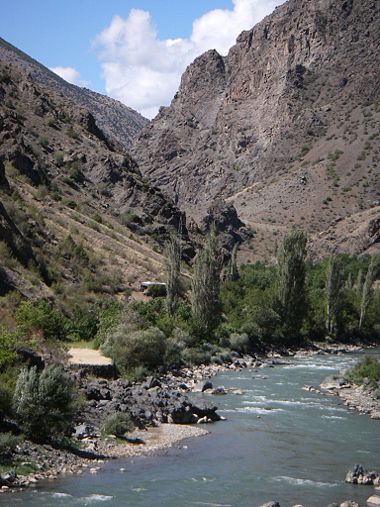
Artvin is an attractive area of steep valleys carved by
the Çoruh River system, surrounded by high mountains (up to 3900 m) and forest
with much national parkland including the Karagöl-Sahara, which contains the
Şavşat and Borçka lakes. The weather in Artvin is very wet, and the forest is
every shade of green imaginable. This greenery runs from the top all the way
down to the Black Sea coast. The rain turns to snow at higher altitudes, and the
peaks are very cold in winter.
The forests are home to brown bears.
The Çoruh is now being dammed in 11 places for hydro-electric power, including
the 207 m Deriner dam and others at Borçka and Muratlı.
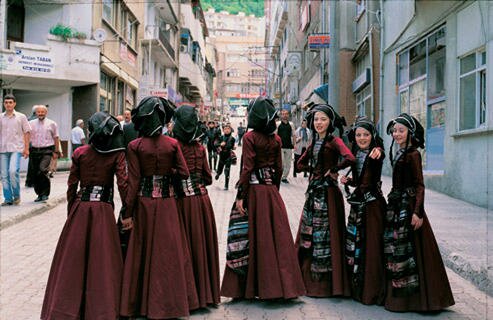
In addition to ethnic Turks, the province is home to communities of Laz people,
and Hamsheni Armenians.[2] In particular, there is a prominent community of
Chveneburi Georgians many of them descendants of Muslim families from Georgia
who migrated during the struggles between the Ottoman Turks and Russia during
the 19th century. With such diverse peoples, Artvin has a rich variety of folk
song and dance (see Arifana and Kochari for examples of folk culture).
Local industries include bee-keeping.
ARTVIN MAP
Etymology
(Georgian: ართვინი; Armenian: Արդվին; Russian: Ардвин,
Laz:Art'vini). Artvin < Artavani "fertile town" < Armenian Arta, arda "arable
field" + vani "district, village, town, church."[Özhan
Öztürk.
Karadeniz Ansiklopedik Sözlük.İstanbul. 2005]
Artvin had been called Coroksi, Corok, Kollhis or Livane
and the area of Artvin today was once part of the larger Ottoman Empire district
of Livane.
Artvin History
The area has a rich history but has not been studied
extensively by archaeologists in recent decades. Artifacts dating back to the
Bronze Age and even earlier have been found. The Hurri settled in the Artvin
area in 2000 BC and were succeeded by the Urartu civilisation, based in Lake
Van. Later, the area was part of the kingdom of Colchis but was always
vulnerable to invasions, first the Scythians from across the Caucasus, then the
Arab armies of Islam, who controlled the area from 853 AD to 1023 when it was
recovered by the Byzantines.
The Seljuk Turks of Alparslan conquered the area in 1064 AD; it was briefly
recaptured by the king of Georgia with the help of the Byzantines, but by 1081
was in Turkish hands again. With the collapse of the Seljuks, the Artvin area
came under the control of the Ildeniz tribe of the Anatolian Turkish Beyliks.
Fighting for control between various Turkish clans continued until the Safavid
Persians, taking advantage of this infighting, were able to conquer the area in
1502.
Eventually the Ottomans of Mehmed II were able to defeat the Greek state of
Pontus on the Black Sea coast and thus control the mountain hinterland too.
Subsequent expeditions into the mountains by Selim I gave them control of a
number of castles and thus the whole district. By 1627, Artvin was securely in
Ottoman hands, part of the sancak of Lazistan.
This lasted 250 years until the area was ceded to the Russians by the Ottoman
Empire following the Russo-Turkish War (1828–1829), and recovered and again
ceded at the conclusion of the Russo-Turkish War of 1877-78. This to and fro-ing
from Russia to Turkey continued with the Treaties of Brest-Litovsk, Moscow, and
Kars. All this fighting and uncertainty between Russia and Turkey in the late
19th century caused the people of Artvin to suffer terribly, with much of the
population moving westwards away from the Russian-controlled zones.
Artvin peoples
Like most towns in Turkey since the 1970s Artvin has seen uncontrolled building
of concrete apartment blocks and ugly government office buildings and has lost
some of its attractive historical feel. But on this clifftop Artvin can never be
a huge city, it's a quiet provincial town.
Before World War I there were many Armenians living in Artvin, today the
population of Artvin is highly mixed, consisting of Turks, Georgians, Lazes and
Hamshenis.
* 2000 23.157
* 1997 20.073
* 1990 20.306
* 1985 18.720
Places of interest
* The city of Artvin has an ancient castle and a number of Ottoman Empire period
houses, mosques, and fountains.
* Every June, there is a "bull-wrestling" festival in the high plateau of
Kafkasör[4]
Popular places for walking and outdoor expeditions.
* The Kaçkar Mountains are among the most-popular venues for trekking holidays
in Turkey.
* Macahel Valley on the Georgian border, is another popular location for walking
holidays.
* Papart forest in Şavşat
* Genciyan Hill in Şavşat, overlooks the border and the Binboğa lakes.
* The lakes of Şavşat and Borçka and the crater lake of Kuyruklu.
* The Çoruh River is excellent for rafting and championships have been held here
(although this must be affected by the hydro-electric projects on the river???)
* There are a number of Georgian churches in the valleys of Yusufeli.
* Bilbilan Yaylası - a typical Turkish high meadow.
* Savangin pre-historical cave with a an inscription written unknown or unsolved
alphabet
Well-known residents
* The singer and politician Zülfü Livaneli was born into a family from Yusufeli.
* Folk rock singer, guitarist and composer Kazım Koyuncu was born in Artvin's
Black Sea town of Hopa.
* The bard of Artvin, poet Turgut Çelik
* Folk singer Şükriye Tutkun
* The father of TV personality Beyaz was from a village in Ardanuç.
* Yakov Zarobyan, 1st Secretary of the Communist Party of Armenia, was born in
Artvin in 1908.
Usefull links
Black Lakes of Artvin province Turkey
Colchis, Armenia, Iberia, Albania
BULLWRESTLING - bullfighting IN TURKEY
East of Trabzon - Trebizond Travel guide |