Son güncelleme: 27.08.2004

Bu sayfa, ölümsüz Karadeniz kültürüne ve gelecek kuşaklarımıza ithaf edilmiştir  
anasayfa
forum mp3'ler videolar makaleler >> fotoğraflar linklerimiz


An interview with Birol Topaloğlu

                                                          Says “best thing” he can do is sing in the Laz language

Plus İçerik / English by Mehmet Akgül
NTV-MSNBC

Topaloğlu says that he faced a ban over his usage of the Laz language when he was a student, a time when speaking Laz was shameful and penalized. Some teachers even set up “anti-Laz language committees,” the singer said. We then asked him to give some of his personal background.
       “I never thought of myself as a professional musician or an artist,” he answered. “I was born in Turkey just like everyone else, but as a child of a Laz family. However since we did not have a chance of being educated in our mother tongue I learned how to speak Turkish at school. My native language is Laz and I learned Turkish after the age of six. At that time I never thought Laz music and culture would ever become a part of world heritage. I got a hold of a Bağlama (a typical Turkish plucked musical instrument with three double strings) and started to play and as I thought it was all a hobby it became more serious. My family was fairly instrumental in my taking up the Bağlama. I used to just play the Bağlama and give concerts at university. Since Laz was not an acceptable language to sing in, I always faced bans on my use of the Laz language in music. These were all reasons preventing the music from coming into daylight.
       We then asked him what he thought about what Laz musicians have been doing up to now.
       “Of course there is the commercial side to everything,” he said. “I think they are not making music, but trade. These people cannot claim to represent Black Sea culture, or Laz culture, nor can they in future. Some of this music is all popular types made with the aim of just selling and having sexual connotations. They have just been making cheap jokes in their songs from cheap material. Do these Black Sea Laz people not have sad mourning, problems and natural disasters?”
       So how has Topaloğlu’s route differed?
       “We are an ethnic group with so few in number,” he answered. “For one to stay close to the real ethnic music and stick to it needs a lot of effort.
       As you know, I live in the Black Sea region and some people were against what I have been doing since they were claiming to have a monopoly on Laz culture and music. Since I see myself as being able to express myself in a free and independent manner, I have made Laz language music. It is a whole lot of fun. This kind of work does not really make big money. Making music with a group of people small in number needs great effort and serious work. I have decided to stand against all these odds — both economically and performance wise. There are some very rich Laz entrepreneurs. I was never supported by them and sometimes they say, ‘there is no need for Laz music and what use is it?’ There are some who say ‘we live in Turkey, so why Laz language music?’”
       We then asked him how far he thought his efforts would go.

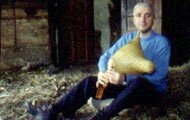
Birol playing  " tulumi " our authentic enstrument , it's smiliar with the Scottish Gaida


       “The degree to which I can be myself is the degree to which I can be universal,” he answered. “Completely independent, able to listen to whatever comes out of my mind... I can say that I am endeavoring to make authentic Laz music, but I am not sure if I have reached that level as yet. Even I am beginning to learn my culture, since I have been away from it for so long.
       One of my wishes is to compile my Laz culture into a CD using the latest technology — thereby making it undying. Actually, what I am doing should be done by the state. It should be embracing all cultures instead of tearing itself away from them. I am on my own visiting villages and listening to old people for their renditions of so many songs and cultural tales to enable myself to use them in my music.”
       We then moved on to some of his more recent compilations.
       “The biggest example and inspiration for me are the songs I hear from old ladies and shepherds in villages in the Black Sea region,” he said. “They are the best examples of songs which we sing together in villages. Making compilations is actually not my job. It is the job of ethnomusicologists, but I am sort of forced into this effort since no serious record of Laz music has been made up until now, there is not a real example around to take notice of. The best examples are the songs sung in villages by the inhabitants. I tape the songs of the old ladies of the villages and my compilation work has now started to become more important as it allows ancient songs to be unearthed.”
       Topaloğlu plans to compile this research soon.
       “We are going to put these, shall we say, ‘authentic’ compilations into a local production album,” he said. “I have nearly completed my preparations and I am very excited by this. I was in the Black Sea region just 10 days ago. I am sure you are going to love these compilations when the album is out.”
       We then asked him about the apparent gender bias in Laz music, as the sources for the songs are always women. Don’t Laz men ever sing?
       “Laz men do sing,” he retorted, “but because they always had to go away from their regions for work far away or abroad it has been hard for them to keep their music alive. Women were always around to tend the land and look after the household, which means they hold the culture together overall. Recently, due to religious pressures, some of the women were not willing to sing some of these great songs, but I persevered and convinced them to sing for me — though they will remain anonymous and will be called ‘women of the highlands.’”
       Finally, we asked what reactions he had received from the world music scene.
       “My album was top of the Canadian radio world music charts,” he said. “I know there are requests to radio stations in America for Black Sea cultural music. This is what I want — to promote the culture of Turkey by enabling the world to realize the rich mosaic of cultures that is present in Turkey.”

He play " doli" a kind of percussive enstrument of Laz's



© copyright 2004 Karalahana.com