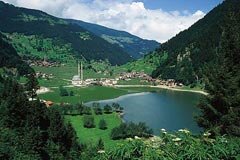
Trabzon is said to be founded in the 7th century
BC by Miletion colonists and then Alexis Comnenes founded
the Comnenos Empire, which lasted until 1461 when the
Ottomans took over the area. The city is now an important
port of trade, continuing its role throughout the history.
Sultan Suleyman the Magnificent was born here and Yavuz
Sultan Selim, another Ottoman sultan, was the regional
governor of Trabzon when he was a prince. The city is mostly
situated on a table like promontory above the harbor. The
citadel is one of the oldest remains, and the first thing
you will notice when entering Trabzon, is a well-preserved
13th century Byzantine Church, now restored as
the Ayasofya Museum. The walls of this church are decorated
with frescoes which are the finest examples of Byzantine
craftsmanship. The Fatih Mosque in the city was once a
Byzantine church. Trabzon is very richly adorned with
sightseeing areas and precious remains from the Byzantine
period. On the western slopes of the Boztepe hill, is "the
Boztepe Park" with a beautiful view of the city. In the
village of Surmene, to the east of Trabzon, is a fascinating
19th century mansion, known as the Kastel. There
are many opportunities in Trabzon to cover all tastes. For
example the Erikbeli and Karadag meadows, south of Akcaabat,
are quite good hiking and picnicking areas.
Taking a northeasterly direction towards the inner parts of
Trabzon and following a delightful mountain road, you can
visit the pretty mountain village of Hamsikoy and taste its
delicious meals, before reaching the Zigana Tunnel, which is
the largest tunnel in Turkey. Then you may head for the
Zigana Ski-Center to feel the real joy of skiing, or for
Gurgenagac, Kirazli and Solma which are excellent meadows
with magnificent landscapes and pure clean air, for outdoor
activities in the palm of nature. The most appealing and
breathtaking sightseeing area of Trabzon is the Altindere
National Park. 47 kms southeast of Macka, this lovely park
provides a fascinating setting for the 14th
century Sumela Monastery of the Virgin Mary, which is
perched on the rock face 270 metres above the valley, at an
altitude of 1300 metres. Within the ruins of the monastery
are the remains of magnificent frescoes. It is a place of
exceptional natural beauty. It was initially constructed on
the steep surface of rock, as a small church in the 4th
century. In the 11th century it was expanded into
a monastery with 72 cells. Ottoman princes, as regional
governors of Trabzon, contributed to the upkeep of the
monastery, providing material and moral support. The
awe-inspiring and magnificent view of the monastery, with
its frescoes and holy water, attract thousands of Turkish
and foreign visitors every year.
Of and Hapseyas bridge
The twin valleys of Of ( formerly
Ophis ) have a historically been the home of some of the
most idiosyncratic , proud and irrepresible communities of
the BlackSea mountains . Once they were famous for their
lawless brigandage ; since their conversion about 300 years
ago , they have also been famous for their flamboyant
devotion to Islam .No other part of Turkey boasts so many
extravagant mosques and religious schools per square metre,
Preachers from Of are sought across the country both for
their learning and their vivid , humorous style .
Greek was the dominant language of
the district until a generation ago .Older people still
speak it as their first language , alhtought they don't
advertise the fact .Of town is uninteresting .The interior ,
by contrast of steep mountains and jungle like forest .
You'll see plenty of rambling old style houses, perched on
impossibly steep slopes where hand operated pulleys are the
only easy mode of transport .Many houses are built with a
technique called kadama ,with blocks of cut cobblestone
fitted into a framework of chestnut . Here and there one
comes across the characteristic roofed suspension bridges of
the region .
Surmene
The tuesday market blooms with thousand of peasant woman
wearing the red kesan .The local maize bread has the
consistency of sweet red pumpkins ; it is extremely tasty
when fresh .The Kastel, 4 km east, is the most magnificient
examole of traditional BlackSea civil architecture to
survive to the present .It was built around the year 1800
for the Yakupoglu dynaty of valley lords , and remains in
the possession of the same familiy, althought it has been
padlocked and left to rot for many years . The Pontian Greek
language is still spoken at home by the inhabitants of some
villages above Koprubasi , further up .
Soganli Pass (60 km S of Of .Alt 2330 m.)
The most spectacular of Black Sea mountain passes negotiates
a 700 metre wall through 22 hairpin bends .Below them is the
wild rainforest of the Of uplands; above is the bleak and
trelss plateau of eastern Turkey , a very different world
.The road was built during World War1 , and does not seem
like it has repaired much since .
Zigana Pass (65 km SW of Trabzon .Alt 2025 metres)
The most famous of all Blacksea mountain passes marks the
point where Asian trade routes historically crossed the
Pontic Mountains to come down to the sea .Here in 3999 BC
the Athenian troops of Xenophon caught their first glimpse
of the sea after a disastrous trek across Mesopotamia and
Armenia .Their cry of Thalassa ! Thalassa ( the sea , the
sea ) has become proverbial .
Behind its chaotic facade Akcaabat ( formerly
called Platana ) preserves a fair number of traditional -
style townhouses . The most attractive of theese are grouped
in the Ortamahalle district , the middle of the three ridges
that form the town . Also here is a church dedicated to the
Archangel Michael , dated 1332 AD, which was used as a
private residence until a few years ago and now lies
abondened in the back of someones's garden .
A magnificient panaromic road continues up from
Akcaabat , via Duzkoy , to the Hidirnebi yayla where the
annual festivities are held on July 15 .
Tonya (21 km south of Vakfikebir) Trebizond
Tonya has a reputation as the Wild West of the East,
an image buttressed by the epic blood feud which decimated
sveral of the town's families and caused a lage part of the
population to emigrate in 70's and 80's. " No Tonyali ever
dies a natural death é is the local wisdom . The number of
tombstones in the town cemetery carrying a pistol sign seems
to support that thesis .
An outsider will find in Tonya a remarkably warm,
proud and friendly people who speak the Pontic dialect of
Greek among themselves . Of the famous Tonyan skill in
making handguns no one will have ever heard about ,
althought an unusual number of hoe and shovel manufacturers
exist in villages of the district .
The famous of all BlackSea highland festivals is held
on the third weekend of July in the Kadirga yayla , about 15
km above Tonya
Culture
in Trabzon Yesterday and Today
It must be
admitted that the best descriptions of Trabzon, where until
the first quarter of this century Muslim and Christian lived
side by side, where the ezan, or call to prayer, mingled
with the sound of church bells, were those of travellers. We
possess no deta led knowledge of the cultural life of the
city before the Ottoman period. However, from the Tanzimat
(reform) Period onwards, when the process of Westernisation
began, Trabzon possessed all the features of the world's
major cities. Various educational establishments are
mentioned in the Yearbooks of the Governor's Office, among
which were the “Mekatip-i Ecnebiye” (or schools for
foreigners), “İptidaiye” (primary schools) and “Rüştiye”(middle
schools). The most renowned school of the period was
“Mektebi Idadi” (otherwise known as the Royal School, or
Trabzon High School). The foundations of this building were
laid in 1884 and built due to the efforts of Sırrı Pasha,
Governor of Trabzon. This was followed by the Trabzon
“Muallim Mektebi” (teacher training college). Trabzon High
School is now the city's oldest school. Affan Kitapçıoğlu
High School, Fatih High School, Kanuni Anadolu High School,
Yunus Emre Anadolu High School, Yomra Sciences High School,
the Girls Professional High School, the Commercial High
School, the Anadolu Commercial High School, the Anadolu
Technical High School, the Industrial Professional High
School, the Imam Hatip High School, the Anadolu Imam Hatip
High School and the Private Ata High School are among the
city's most renowned schools.
One of the
Village Institutes, which were the most respected of our
country's educational establishments and served as a model
in world educational history, was opened here at Beşikdüzü
in 1940. However, political developments in later years
made this excellent institution a thing of the past.
An
important example of Trabzon's educational establishments is
Karadeniz (Black Sea) Technical University. A resolution was
passed by Parliament for the setting up of this university
on 20 May 1955 and it first opened on 2 December 1963 in a
primary school building in the Maşatlık district of Trabzon,
and later moved to its present site. After engineering, new
faculties were added over the years to include the Faculty
of Education, the Faculty of Economics, the Faculty of Water
Products and Oceanography at Sürmene, the Faculty of
Architecture and the Faculty of Medicine. The university's
very first students were young people who had completed
their high school education in different parts of the
country. These young people, with all the enthusiasm of that
period, also became involved in theatrical while they were
studying and took this art back to their villages.
At about
the same time the Fatih Institute of Education opened in
Trabzon. In the course of time the Institute was turned into
a faculty and became part of the Black Sea University. This
process brought thousands of young people into the teaching
profession.
The fırst
Turkish newspaper, named “Trabzon”, was printed at a
printing works attached to the Governor's Office, founded in
1866. The first copies of the newspaper reached readers in
1869. In the course of time other newspapers, among them
Meşveret, tkbal, Envar-i Vicdan, Haber Anası, Tarık, Hekim,
Temkin, Istik- bal, Güzel Trabzon, Zafer, Kahkaha, Devekuşu
and Zafer were set up. There were also magazines such as
Genç Anadolu, Kaygu, Özdilek and Yeni Mektep.
In the
last quarter of the l9th century, when the Second
Constitutional Government was in power, the Byzantine Greek
and Armenian communities in Trabzon published newspapers
and periodicals, and this situation continued until the
First World War.
A newspaper
called Yeni Yol, which is the same age as the Turkish
Republic, was publıshed in Trabzon after Giresun, and its
appearance coincided with Atatürk's first visit to Trabzon.
At about the same time, Ilk Adım ( 1924) and Yeni Ay (1926),
magazines published by Hüseyin Avni Bey, a primary school
inspec- tor, pedagogue and poet brought new colour to
Trabzon's local press.
The
Halkevleri, which were local adult educational centres, were
set up in 1932 and sixty four issues of a magazine
calledinan were published under the aegis of this centre of
culture between 1937 and 1949.
From 1932
to 1923, Akın magazine, which occupied an important place in
the cultural and artistic life of Trabzon, appeared. In the
same year a single issue of a magazine called Trabzon Lisesi
appeared as the organ of Trabzon High School, where it was
published. In 1946 the school was represented by Boztepe
magazine. Then in 1949 Değirmen appeared and although its
survival was to be confined to 9 issues, it aroused a great
deal of interest, and was published single-handed by Halit
Tanyeli, a teacher of literature. On 24 February 1956, a
newspaper called Hakimiyet was added to Trabzon's
newspapers. It was to serve as a voice for poet and
journalist Ömer Turan Eyuboğlu throughout the 33 years of
its life.
In the
course of time the people of Trabzon became acquainted with
such news- papers as Halk, ileri, Doğu, Trabzon, Yenigün,
Son Haber, Karadeniz and Kuzey Haber. Trabzon is now
represented locally by four newspapers, one of them weekly (Ekspres)
and the others (Karadeniz, Karadeniz Olay and Türk Sesi),
daily. Bayram and Manşet, published by the Journalists
Association, also joined this caravan. When Ömer Güner was
chairman of the Trabzon Journalists' Association he arranged
special programmes in the knowledge that he had a duty to
respect the talents his city had produced and take an
interest in their work. Among the many great journalistic
talents born in Trabzon were Cemal Rıza Osmanpaşaoğlu, Bekir
Sûküti Kulaksızoğlu, Faik Ahmet Barutçu, Ali Kemal Hatipoğlu,
Ali Becil, Muzaffer Korlu, Şevket Çulha, Ömer Güner, Ziyad
Nemli, Özgür Baran, Atilla Aşut and Hikmet Aksoy.
In his book
of poems “Yurdumdan” (From my Country), published in 1960,
Ceyhun Atıf Kansu had this to say about Trabzon:
“My lovely
has risen and opened her window to the morning
From one of
Trabzon's foamy wave-like homes
Shaken her
dreams out of the window
Looked at
the thin coverlet of blue sea
Right in
front of the house.”
In 1961
Kıyı magazine appeared. Eleven issues appeared in 1961,
nineteen in 1969, twenty one in 1981 and one hundred and
twenty eight issues have been published between April 1986
and November 1996, these being the standard-bearer of the
cultural and artistic life of the city of Trabzon today.
In the
course of time a number of other magazines, such as Kemençe,
Çıkın, Ezgi, Horon, Yakçn Kültür, Trabzon, Uzun Sokak and
Birlik appeared in Trabzon. Another magazine which has
printed 20 issues so far is a musıc magazine called Mavi
Nota.
Darülbedayi,
a theatre group which came to Trabzon from Istanbul to put
on plays in the early years of the Republic worked hard to
instil a love of the arts into the people of the city. These
performances were followed by activities organised by the
Halkevi (adult education centre previously referred to).
Over the years the Halkevi produced plays such as “Akın”
(Foray), “Kahraman” The Hero , “Istiklal” (Independence),
“Şeriye Mahkemesi” (The Şeriye Court), “inkılap”
(Revolution), “Himmetin Oğlu” (Son of Endeavour), “Hedef”
(The Aim) and “Mete”.
These
Halkevi activities were followed by those of the football
clubs. The theatrical group attached to the İdmanocağı team,
founded on 20 January 1921, staged such plays as “Sultan
Osman'ın Mezarında” (In Sultan Osman's Grave), “Şeriye
Mahkamesi” (mentioned above), “Gömdüğüm O Cihan” (The World
I have Buried) and “insan Sarrafı” (A Good Judge of Men).
A play
called “Gazete Düşmanı” (Enemy of Newspapers) was put on by
Gençler Birliği, which was founded on 4 July 1923. Another
of the city's football clubs was Necmiati, founded on 14
March 1923. Among the plays performed by the theatre group
of this club were “Kanun Adamı” (Man of the Law), “Tavsiye
Mektupları” (Letters of Recommendation), “Bir Damla Yaş” (A
Tear Drop), “Köroğlu”... “Baykuşu” (The Owl), “Hasbahçe”(The
Royal Garden), “Istiklal” (referred to above), “O
Kadın”(That Woman) were among the plays performed by the,
Idmangücü team. Together with the above, plays put on by the
Doğan Gençlik theatrical group of Birlikspor encouraged a
love of theatre in the people of Trabzon.
An amateur
theatrical group was set up in 1962 under the directorship
of Haluk Ongan and its activities continued uninterrupted
until 12 September 1980. Examples of their productions are
“Duvarlann Ötesi” (Beyond the Walls), “Zafer
Madalyası”(Victory Medal), “Fatih” (the Conqueror), “Tuzak”
(The Trap), “On iki Adam” (Twelve Men), “Bir Tavsiye Mektubu”
(A Letter of Recommen dation), “Linç” (The Lynching) and
“Şili'de Av” (Hunting in Chile).
This
intensive artistic activity formed the infrastructure for
another organisation in 1987. The Trabzon State Theatre was
permanently established in Trabzon and soon took root there.
It is already in its tenth year of existence and the large
number of plays it has staged have raised the tastes of
Trabzon theatre-goers to the highest level.
Trabzon
yesterday and today has produced a number of men and women
of the arts; Hamamizade Ihsan Bey, who wrote a book about
anchovies, the satirical poet Halil Nihat Boztepe, the
eminent poet and novelist Hasan İzettin Dinamo, our great
thinker Sabahattin Eyuboğlu, the poet and painter Bedri
Rahmi, all of whom carried the colour of Trabzon's soil with
them throughout their lives. İsmet Zeki Eyuboğlu was a
respected figure who wrote many books and articles about his
research , and critical works as well. Then there is Ömer
Kayaoğlu, author of “Trabzonlu Kemençe” (The Rebec of
Trabzon), whose original poetry resembles a folksong or
chant, Subutay Hikmet, author of “Dünyanın Tadı” (The Taste
of the World) and “Zaman Boyutu” (The Time Dimension), Nabi
Üçüncüoğlu, author of “Memleket” Native Soil), Gündoğdu
Sanımer, whose creative work continues after “Karayelin
Sürüleri” (Herds of the North Wind), Hüseyin Atabaş, a poet
who always carries Trabzon in his heart and Ahmet Özer, who
celebrated thirty years as a poet in 1996 with the 10
volumes of his poetry that have been published. Let us not
forget Kenan Sanalioğlu, who has established a reputation
with his translations and poems, Hasan Hüsnü Durgun, who has
produced two volumes of poetry so far, Hüseyin Alemdar, a
poet who has also been involved in cinema, Raif Özben, who
knows full well whence love flows (Sevginin Aktığı Yer),
Öner Ciravoğlu, who has given us “Kalepark” (Castle Park),
one of Trabzon's finest and most upstanding men in the
shape of Yaşar Miraç, Hüseyin Haydar, the love-sick swain of
“Afidem”, Ali Mustafa, illuminated by his work “Şağdaüş
Yangınlar” (Contemporary Fires), Özer Ciravoğlu, who has
never ceased to be a poet, Sunay Akın, who has devoted his
life to poetry, Çiğdem Sezer, whose sensitivity has brought
fresh dimensions to our poetry, Neriman Calap, who has
always enjoyed the beauty of being a poet and İhsan Bektaş,
who cannot live without poetry. To these we can add the name
of Yaşar Bedri Özdemir, who both paints and writes poetry.
All of these poets and poetesses have made their own
contribution to Trabzon's world of the arts. Apart from the
efforts of painters such as Yusuf Katipoğlu, Muzaffer Akyol,
Veysel Günay, Süleyman Saim Tekcan and Mustafa Ayaz, whose
fame has spread far beyond Trabzon, we have also witnessed
works featured in countless exhibitions in the city centre
by a number of other artists.
The labour
of writers such as Cumhur Odabaşçoğlu and Ömer Akbulut, the
devotion to his art of masters of the Turkish language like
Rasim Şimşek, the names of Ahmet Can Bali and Aliye Aşırbalı,
which are part of the city's history, the unstinting efforts
of Ahmet Selim Teymur to cultivate a love for classical
Turkish music and his contributions to Kıyı magazine and the
love of historian Mahmut Goloğlu for Trabzon are further
dimensions of these efforts.
We come
across a number of flourishing arts organisations in Trabzon
today, the most striking example of which is a photographic
club called Foto Forum, which has organised a number of
events and exhibitions since its inception. The
Caricaturists' Association has created a fondness for this
branch of art outside the big cities and the Black Sea
Writers' Association has extended a warm welcome to all and
organises various events. The "Trabzon" yearbooks published
in Istanbul and Ankara add a touch of joy to the love
fostered for this city. We can also add to these different
organisations the Trabzon High School Old Students'
Association and a number of music groups. Vocalists who sing
the folk songs of the region in other parts of the country
cannot live without the lifeblood of Trabzon inside them.
The music of Volkan Konak is another embellishment to the
soil of Trabzon.
The
Province's Public Library is a focal point for culture, this
time the culture of books, and it boasts of history of 70
years. The various cultural centres in the city, which are
under the supervision of the Municipality, also provide a
venue for events. We must also mention the crafts of the
Trabzon region, the most important of which are beaten
copper and jewellery. Trabzon possesses bazaars where
exquisite examples of both these crafts illuminate the area
around them with their gentle sheen. Trabzon is the home of
the quilt-maker's craft in Turkey as well.
Nature
possessed an entirely different beauty in the Trabzon of
yesterday; Ganita, with its crystal-clear sea, was a source
of renewal for our love of Trabzon, its gardens were full of
orange, pomegranate and fig trees. The classical music
played in Meydan Park, accompanied by the voice of Hafız
Burhan, created another world. Now we see that so much of
Trabzon's valuable heritage has become a thing of the past.
The famous Sümer Cinema survives only in photographs;
Suluhan and the Şems Hotel, like many cinemas and precious
parts of Trabzon's heritage have been destroyed, leaving
behind them nothing but yearning...
The rhythm
of the round dance, which completes this wealth, has never
been absent. Even though today's cultural focus may not be
the same as the ebullience of yesteryear, both press and
publications are in a constant process of renewal. Kıyı,
which is Trabzon's only regular art magazine, causes the
name of Trabzon to reverberate in the world of art and
culture. Trabzonspor, which has been on the city's agenda
for the past 30 years, is a driving force which gently
guides the people of the region in their daily lives.
And what
about tomorrow? Joint international programmes could be
implemented and local resources mobilised to organise
festivals and book fairs which support the cause of peace.
The authentic cultural fabric of the city could be preserved
by making use of world resources, and, most importantly, an
open-air museum could be established. An end could be put to
the arguments abouitbuildings which have been the source of
three civilisations. Trabzon's historic fabric and tourism
resources could be recorded. The matter of a press
encyclopedia could be put on the agenda as well. The work to
be done in this sphere could lend impetus to Trabzon's
thousands of years of history, carrying the love that people
have for their city forward as a heritage for the
generations of the future.
Major
Historic Buildings in the City of Trabzon and Districts of
the Province
Trabzon is
a beautiful city on Turkey's Black Sea coast. The traders,
travellers and scholars who have visited it throughout the
centuries have always described Trabzon in the following
distinctive terms; “The cities along the Black Sea coasts
resemble a string of pearls, and Trabzon is like a brilliant
diamond among them.” The eastern Black Sea coast once
resembled an isolated coastal strip surrounded by mountains
to the south. However, Trabzon, which lies in the middle of
this area, has always been an important centre because of
its natural resources, its harbour and its direct link with
the Silk Road over the Zigana Pass. Land surveys and
excavations carried out in recent years have revealed that
Trabzon and its environs were the site of Bronze Age
settlements. In the millenia that followed, a palimpsest of
cultures and civilisations were founded in Trabzon. On the
fertile soil of Trabzon's green hillsides crops grew in
abundance, and the city developed a strong economy and
historic tradition, becoming a centre of science, culture
and art.
Research
into Trabzon's historic buildings has been concentrated
mainly on the Byzantine-Komnenos period and churches and
monasteries erected in the Ottoman period. Work of this
nature started by J.P Fallmerayer at the end of the last
century dealt with churches, monasteries and other
structures in the centre of the city. Later research
extended to l9th century buildings in the villages. Western
researchers have always been interested in Trabzon's natural
beauty, history and historic buildings, much of which was
prompted by feelings of a romantic nature.
The Mountain Plateu Culture and Plateu House of the Trabzon
Provice
This mountainous region of the country has a temperate
climate all the year round with frequent rainfall. The
plateaux lie in the foothills of these high mountains. In
between the forests, where a large variety of trees and
flowers are to be found, are the plateaux with their nomad
encampments. The most renowned of these plateaux are
Erikbeli, Derinoba, Karadağ and Sultan Murat.
The villages in the area were first established in the
valleys of streams flowing seawards from the mountains. The
villagers raise agricultural crops which vary according to
location, the main ones being tea, hazelnuts and maize. They
also earn a living with livestock breeding. The winter
months are spent resting in the villages, doing seasonal
jobs and handicrafts. When spring comes cultivated fields
are dug over and sowing takes place in May. Families who
have arable fields migrate to their houses there and stay
for up to a month, taking their livestock with them. Then
there is a general migration to the mountain plateaux
between the beginning of June and the end of September.Upon
their return from the plateaux these families return to the
land in the “mezra”, where they stay for one or two months.
Once snow starts to fall and the weather becomes really
cold, everybody returns to their village.
This land is located in a “mezra”, or hamlet some distance
from the village. The mountain plateaux are completely
deserted in winter. In spring, when the snow begins to melt,
the menfolk go up to the plateaux to see whether any damage
to the house has been caused by wind and snow and do any
necessary repairs. They also take advantage of this visit to
mend the fences surrounding their pastures. Meanwhile in the
villages preparations for the migration to the plateaux
begins. Any items required are purchased, the cowbells
repaired if necessary and the cows' headdresses made and
dyed. The day for migration is decided by all the villagers
because they will all take their livestock to graze the
fresh grass of the pastures. Generally speaking, if the
crops have been sown and the weather is suitable the great
migration to the plateaux takes place in the first week of
June.
It is the eldest of the family or the mother's eldest son
who first leaves the house with a prayer on his lips. The
mules and donkeys are loaded and the adults carry bundles
and baskets on their shoulders.All these little processions
meet and assemble on the road leading out of the village,
and together they set out for the mountains.
I'll be off to the pastures
Setting off along the roads
You can come and find me
By asking where my house is
This migration is accompanied by music.When the column
pauses to rest, songs are sung and round dances danced to
the accompaniment of the rebec, drum and zurna. The
population of villages whose plateau is distant rest in
large tents or in their houses at the “mezra” along the way.
There is more entertainment in the evenings. Many villages
in the Şalpazar district of the Trabzon province still
migrate en masse to the plateaux, with big celebrations
along the way.
The plateaux are verdant, with innumerable varieties of
flowers; the air is filled with butterflies and the
chattering of mountain streams.They are surrounded by
forests of oak, pine and other species. The birdsong in the
forests and on the pastures, the melodious ringing of the
cowbells mingling with the bleating of goats and sheep are
deeply moving. The indescribable beauty of the plateaux
changes with every passing hour of the day and the local
people express this beauty in hundreds of folk songs.
The word “yayla” (plateau or mountain pasture) is one which
includes everything - the forests, pastures and encampment.
Life on the plateaux means that certain things have to be
done. The women undertake the domestic tasks, feed the
livestock and look after and milk the cows. The men cut
firewood for the winter and do other jobs relating to the
forests.The children are given jobs according to their ages,
but most of them graze the livestock. Certain crops are sown
on the plateaux, for example barley, rye, potatoes and other
vegetables such as cabbage and onion. From the milk produced
by the cows cheese, butter and skim milk cheese are made.
Some families even take their beehives and chickens up to
the plateaux. Some of the products are sold, some consumed
and some put aside for the winter.Together with economic
activities of this kind, hay and firewood are prepared for
the winter.
The mountainous nature of the area and frequent rainfall
make life on the plateaux difficult. In the Salname (Year
Book) issued by the Governor's Office in 1905, the following
comments are made.
“The plateaux to which the population of the coastal regions
migrate in summer stretch away, one behind the
other.Wherever you cast your eyes the nature of the terrain
is so rough that you immediately realise just how agile and
mobile the people who live here have to be... Sometimes
dense mist makes the beauty of nature displayed before your
eyes a moment ago completely invisible...”
However, in spite of the conditions prevailing in their
geography the mountain plateaux have always been loved for
their cool air, icy streams and green grass.
The mountain plateau houses of Trabzon are small, with a few
rooms inside.In fact, they are a scaled-down copy of the
houses in the villages and are made of wood and stone. Earth
is used for the roof on plateaux further inland which have
less forest and wood is used in the remaining areas. The
scarcity of timber in recent years has led to the use of
bricks, tiles and sheet metal.
The plateau houses are, like the houses in the villages,
two-storeyed. Half of the ground floor is used to
accommodate livestock and the walls are of stone.The whole
of the first floor is living accommodation. There are
differences in the architecture of these houses in the east
and west of the province.
In the houses on the Akçaabat, Vakıfbekir and Tonya plateaux
there are two doors, one on either side, leading into the
kitchen.Here the floor is of earth with a stove in the
middle. Next to the stove is a raised platform with a divan
on it where the aged can lie. The kitchen is a place where
meals are cooked, jobs are done and where people sit. In one
corner of the kitchen is a cupboard and shelf where pots and
pans and a water tank are kept. Access to the stable below
is via a trapdoor. Between the kitchen and larder is a
raised wooden platform. The young couple of the family sleep
in the larder, where milk and cheese are also kept.
In the plateau houses in the east of the province there is a
space referred to as “otana”, a small entrance hall which
gives access to the kitchen, and from there entrance to the
larder or room is direct. Part of the kitchen floor is earth
and part of wood.Sometimes there are as many as two rooms
opening into the kitchen,
where the stove and water tank are. These rooms are used for
the storage of milk and cheese.
Each house has a certain area of fenced pasture allotted to
it. There is a small garden in a part of the pasture nearest
the house where vegetables such as onions and cabbages are
grown. Households which own sheep also have a sheepfold near
the house. Cows and sheep are grazed in areas further from
the house. There are also a few buildings such as a mosque,
caf, bakery and shop up on the plateaux to serve the basic
needs of the people who are spending the summer there. A
market is held on Fridays in the bigger encampments and
people come from neighbouring encamp-ments to do their
weekly shopping.
Among the jobs that are done together on the mountain
pastures is haymaking. When work in the fields comes to an
end in the villages all the adults and young couples start
to mow the hay on the mountain pastures, for this must be
done while the weather is still fine.More and more people
come to the encampments while this is taking place. The
young people who have spent the day mowing hay spend most of
the night enjoying themselves.
The great traditional gatherings up on the plateaux, known
as “dernek”, still take place.They first started centuries
ago and have become quite legendary. I should like to dwell
briefly on these festivities, which now tend to consist of
entertainment.
1- Kadırga-Otçular Week This takes place on the
sloping pastures at Kadırga, on the boundaries of the
Akçaabat, Tonya, Maçka and Torul districts. Next to the
little shops and stalls surrounding the area where the
festivities take place is a biggish area set aside for
worship in the open air. The little shops of Kadırga are
open from May onwards.
The festivities at Kadırga take place on the third Friday of
July. Large groups of people set out from the surrounding
villages and encampments to join in the entertainment and
celebrations. They arriv dressed in traditional costumes,
singing and dancing to the accompaniment of the rebec, drum
and zurna. The men lead, followed by the women.The
procession and dancing are directed by men either on foot or
on horseback. They enter the Kadırga plateau in groups to
perform a round dance together, then break up into smaller
groups; thus the entire plateau is full of dancing rings of
people. This is followed by a feast. The shopping is done in
the evening and they then return to their villages or
encampments, singing and chatting.
2- The Hıdırnebi-Karadağ festivities These take place
in the Hıdırnebi Mountains of the Akçaabat district on 20
July each year (according to the old calender this would be
the seventh day of the Month of the Sicle). The festivities
are attended by groups of people from the Akçaabat, Tonya
and Vakıfbekir encampments. Hıdır or Hızırnebi must be the
site of a saint's tomb. The festivities are much the same as
those at Kadırga, with a feast, singing and dancing.
3- The Sis Dağı (lit “foggy mountain”) festivities
Held at the end of July or beginning of August and organised
by the villages around Şalpazarı in the Vakıfbekir district
of the province, these festivities take place in the
encampment on Sis Dağı. Many visitors from the Beşikdüzü,
Şalpazarı, Eynesil, rele and Tonya encampments also attend.
Oh, Sis Dağı, Sis Dağı
You could not melt your snows
Let this year, too, pass like that
Oh, worry of my heart
4- The Yayla Ortası festivities
This event is held on 20 July on the Sultanmurat Plateau of
the çaykara district and is attended by people from Of and
Sürmene as well.
Apart from the events mentioned above, gatherings such as
the Honefter, Karaptal and İzmis (Sivri Tepesi) festivities
are also held.
A ceremony to commemorate those who died in the First World
War is held on the Sultanmurat Plateau at çaykara on 23 June
every year, and this is also attended by members of the
public.